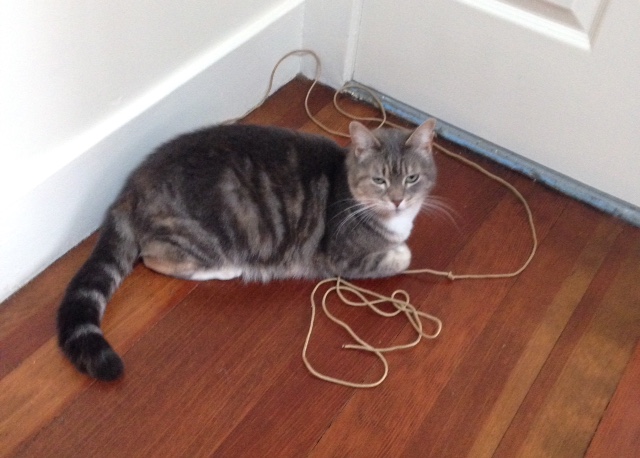
When the sun sets – red – in the trees,
I lie in the new grass.
The cat comes, too.
Together, we sink into earth,
sniff the soft, green, blanket that holds us,
breathe in harmony.
We purr.
***
meb/02/2015
what I've learned from life, by Mary Elyn Bahlert
When the sun sets – red – in the trees,
I lie in the new grass.
The cat comes, too.
Together, we sink into earth,
sniff the soft, green, blanket that holds us,
breathe in harmony.
We purr.
***
meb/02/2015
The anthropologist and spiritual teacher, Angeles Arrien is credited with these 4 rules for living: Show up. Pay attention. Tell the truth. Don’t be attached to the outcome.
***
Tell the truth… that’s something we were taught as children, wasn’t it? I know I was. I remember vividly one of the first times I did not tell the truth – to my mother – as a child. I was playing with neighbor kids, far enough to be as independent as I could be at that age – about 5 – and close enough for Mom to keep a watchful eye out the front screen door that led onto the porch on our upper flat. At some point, I slapped a little girl in the group. I don’t know if it is a memory trick, or if it happened this way, but I saw my mother at that moment, checking to see that I was safe on the street.
When I got home that day, Mom asked me whether I had hit one of my playmates. I said no, that it must have been another little girl who looked just like me. Mom must have been stunned – at my creativity and at my sense of being right – because I saw – and vividly remember – a look of enjoyment and understanding cross her face. Nothing more was said.
We assert our independence as children by not following the rules our parents taught us, and if we are on the path to grow into conscious adults, we continue to assert our independence from our parents, over the course of our lives. And as we assert our independence, hopefully, carefully, and with great discernment, we discover what is true, for us, for who we are, separate from our parents and what was true for them.
Telling the truth is not easy. First of all, it means that one has come to know that we often do NOT tell the truth. We remember and speak what was true for others. We hide our feelings. We ignore feelings we do not want to feel – are in the habit of not feeling – and so we cannot tell the truth of what we feel, in this moment, now.
Sometimes, if we are on a journey, and for awhile, we say someone else’s truth, because we do not yet know our own. “I have to be positive,” we say to ourselves, and so we ignore what is true for ourselves and instead say what would go over well with our latest self-help guru. Or we quote scripture, without having questioned its meaning, without having considered how and if it might apply to me in my own circumstances. It’s easy to get stuck here, to not grow any more, because we think we have found “truth.” All along, we still do not know what is true for ourselves.
In my own life, I remember coming to the place where I began to know and to feel – as if for the first time – my own feelings in response to something that happened. I remember learning that I had to trust what I knew in my body as much – perhaps even more – than what my roiling thoughts were telling me. I remember that when I first began to truly know what was true for me, I often could not say that truth without raising my voice.
Sometimes, I’m like that now. Maybe I have to speak loudly enough so that I can hear!
But sometimes now, I speak truth that is truth to me, in this moment, in this circumstance, with this person, in this particular situation. What is true is not some long-remembered “rule” from my childhood, or my religion, or someone I admire. What is true is what is true for me. I have learned that I can speak what is true quietly – very quietly – because what is true is what is meant for me, only.
And when I speak my truth, I can walk away without caring about how the other person responded. Telling my truth is not about changing someone else’s mind. When I “tell the truth,” I am complete. I am not concerned about changing someone else’s mind – they have their own journey to the truth for themselves, after all, and I cannot know what that journey may be for them. I am complete simply because I have honored truth, my truth, I have spoken it well, and I am complete. When I speak my own truth, I respect myself, and I respect the other. In fact, if I have honored my own truth, I can listen more fully to someone else’s truth. I can listen for the deeper truth beneath the words, as I have done for myself.
***
I love these 4 rules for living. I know it is not easy to live these rules. Sometimes in life, I come across some idea or some short thought that fits. I like to say that one could live their whole life, turning that thought over and over again, trying it on, seeing when it fits and when it does not fit. These 4 rules are like that for me. This is not the only truth I have held inside, turning over inside myself like one turns a stone over in the palm of one’s hand; one favorite for me, that I have returned to many times is this: “give thanks in all circumstances.”
But these 4 rules for living are good, solid rules. I like them because they are not easy. They are not easily won, as if they can be honored without questioning our own thoughts and our own lives, as if they can be lived without hard work. But they are good rules.
Next, “Don’t be attached to the outcome.” (oh, noooooo!)

“Practice makes perfect” was Miss Schmidt’s mantra. Miss Schmidt, third grade teacher, white-haired and in her navy blue dress with white polka-dots, black shoes. Thank you, Miss Schmidt! I got the message, internalized it, translated the message to my own liking (we all do that), and lived a long time trying to be as “perfect” as I could be. Thank God, “practice makes perfect” only lasted so long, and then? Then, it “fizzled” out in my mind, and in my life.
Oh – freedom!
The first time I challenged my wanting to get things right was in a class I took for several years: “Aikido as Spiritual Practice.” The class was a combination of movement and dharma talks (The Intuitive Body: Discovering the Wisdom of Conscious Embodiment and Aikido [Wendy Palmer]).
We started each class on the mat, after we had entered the room, removed our shoes, and bowed to the gathering class, teacher and students. Barefoot, we faced the mirrored wall, our teacher facing us, and moved together through a series of simple practices. For some reason, “let’s practice,” the words spoken by the teacher as she led us through our warm-up, was in my mind on that one particular day. I moved awkwardly, furtively watching the teacher and the other students. Was I moving correctly? Why did she look so graceful? Can I do it like him? Above all, am I doing it right???
I felt – awkward. Check this out for yourself: feeling awkward is a heavy thing. It weighs you down.
Then, something snapped or switched or jerked in my mind. I stopped watching the others, and I began to “practice” from the inside, rather than the outside. I began to feel the movements. I was free! In my mind, I was 5 years old again, fully myself, my little girl legs dancing and thrashing, and it all coming out – perfectly! I could feel that little girl, sense her insides, my insides. I was free!
I have not forgotten that moment, that moment in time when I broke free from Miss Schmidt’s mantra: practice makes perfect. I expect that in many ways, Miss Schmidt was right. But we all have our own translation of what we hear, of what comes into us, of what we remember, and value – or remember, and discard.
Practice means that: simply practice. When life is practice, we become free. When life is practice, there is not getting it right or wrong. When life is practice, there is movement. When life is practice, we can move from one practice to the next, allowing what does not work, what has not worked, what will not work to freely move along.
We talk about spiritual practice. Spiritual practice is like that, too. Practice is only practice, not perfection. There’s a difference. There are no perfect feelings, no perfect objects brought to completion. What is perfect quickly loses its shine, and that’s part of life. So – practice. Don’t practice to become perfect. Don’t wait for the perfect time. Don’t expect to not have feelings that aren’t “perfect,” or “good,” or positive. Just practice.
Make of your life, this: practice.
 Beauty is there, in every moment.
When our lives are busy, we miss the moment. That is a loss in our lives, that we do not see the beauty, the iridescent beauty in each moment.
When I sit in the morning, cup of coffee – a little bit of milk, thank you – in hand, if I am awake and aware, I see the beauty of the day as it arrives, moment by moment, moment by precious moment. I gaze, I don’t stare, but I gaze with a soft gaze at the tree and the sky beyond, just outside my front window.
There, there – I catch for a moment a certain shade of light, the light of that day, that moment, that morning, that season.
Ahhh… as I gazed a few mornings ago, a rainbow drifted across the sky, the air filled with some drops of moisture that day. The rainbow gleamed. I stepped out onto the porch to see it arc across the sky, end to end, that ephemeral, transient beauty. From one moment to the next, it dissolved into nothing. Now, it is only a memory, a memory of a deep and rich and passing moment.
Moments are attached to feelings, feelings, that great gift and burden, of being human. In the moment, in the feeling, there is the hint – always the hint – that this is passing, that this is brief, that this, like everything else, will die. This moment will be gone. This moment of beauty, of the fulness of life, of great feeling, will be gone… is gone.
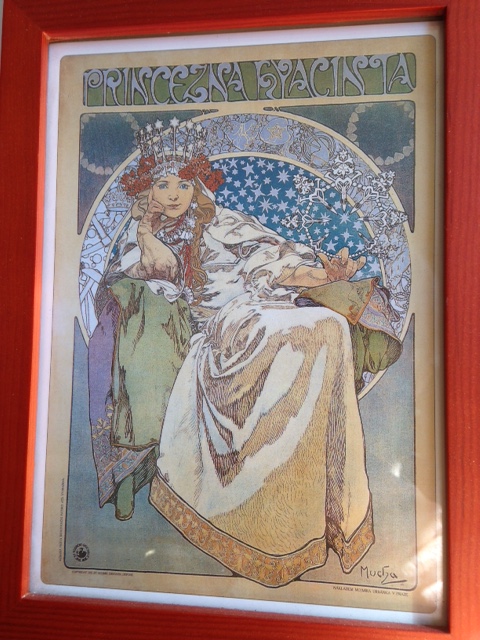
One day, I sat at my wooden desk. On one corner of the desk I have framed a greeting card, an imaginary, art nouveau woman with a flowing robe and flowing red hair. She is surrounded by architectural design rather than an ordinary room or place. The image is a myriad of colors, representative of that time and place, that form of art. But that is not what the image brought to mind. As I sat that day, I was touched, to my core, with the beauty of that image, that imaginary image of a life, of a moment, filled with color, beauty.
And then, I was sad, or filled with longing, or fear, or loss. I was filled with deep feeling, a sort of melancholy. One day – today? tomorrow? the next? when? – I would not be able to know such beauty in this particular form, in my being, in my body, in this place, in these surroundings. This moment of beauty, of absolute beauty, was passing, and as I reflected, had already passed.
***
These mornings, I watch the passing of the moments as the days break. I watch, also, the passing of seasons, of time as each day becomes longer than the last. There is something so human, so sentient, in each moment. In all the days and years that have passed, how often have I rushed from one important meeting, event, gathering, to the next – and been completely unaware, at the same time, of the beauty of this particular moment, this light, this being-ness, this breath, this sound, this color?
If the gift of being human is to be cast into these bodies, these feeling bodies, then the gift is to receive the pain, the absolute pain and power and beauty of each moment. When we miss it, it is gone – forever. Forever gone, and missed, completely eradicated from existence without one knowing, one awareness, one breath caught, one feeling, one deep emotion.
Like you, I have missed so many of these moments of my life. They are all around us, I am sure, ready to be seen, not grasped, but simply experienced, known, loved, accepted. Words fail me. Experience passes. Life continues – with all its importance, its business, its agenda.
Gaze. Gaze at the world around you, your world. See. See what is. Now. Live it, now.

That’s it. Great rule to live by. That’s all it is, complete wisdom in one sentence:
Don’t believe everything you think.
Maybe you’re like me. I have a busy, busy mind. My mind is interesting – yes, very interesting. Your mind is interesting, too. I guarantee that! I’m smart. I’ve known that since I was young. I’m sure you’re smart, too. Those things are true.
We honor the mind, our thinking mind, in our culture. If we think something, we believe it is true. As human beings – as these wonderful works of wisdom – we limit ourselves by living within the cultural constraints of our minds. It is counter-cultural to open yourself to the wisdom that lives within you, within you and outside of the limitations of your thinking, even your best thinking.
Thinking can only take us so far – and there is so much farther to go! Your body is a place of wisdom. Begin to know your body’s wisdom by feeling your feelings. When something happens to you, take a moment to experience that event in your body. What are you feeling? Breathe! Breathe for a moment, and feel the breath in your body. Now, what are you feeling?
As you practice this, you can begin to name your feelings.
A long time ago, someone asked about me: “I wonder if she knows the difference between her thoughts and her feelings?” I am grateful that I took notice of that comment. Do I know the difference? I do now. From that moment on, I began to observe – to feel – my feelings. That in itself is a journey. When we begin to include our feelings in our answers, in our decisions, in our observations, we encounter another dimension of ourselves. When we include our feelings, our perceptions deepen, our love deepens, our experience deepens.
Your body has a wisdom that your thinking mind cannot perceive. In a way, your thinking mind is on one plane of existence. The wisdom that is beyond your thinking mind has deep roots, roots in the earth. The wisdom beyond your thinking mind perceives on many levels, levels that your thinking mind simply cannot conjure up!
If you are sad, feel sad. That is practice. If you are lonely, feel lonely. That too, is practice. If you are happy, feel happy. That is practice. From moment to moment, the practice of reaching beyond our thinking mind takes us into new territory.
A good parent teaches feelings to their child by mirroring those feelings. When the baby cries, mom will say: “oh, you are sad.” Or she will say: “you are angry that your plate fell on the floor.” Dad will say to a toddler: “you are frustrated because you can’t reach the ball.” Sometimes, we have to mirror our own feelings to ourselves. We have to begin again to learn about ourselves, and about our own perceptions of the world.
Maybe you’ll need help as you begin to discern your feelings. Maybe a therapist can help, a professional who can ask you, again and again: “So… how do you feel about that?” Maybe a spiritual guide can teach you to listen to your body’s wisdom as much as your mind’s wisdom. Maybe a 12 step meeting will be the place you begin to learn.
Each one of these places can be the doorway to growth, to growth in consciousness.
Such simple practice, to not believe everything you think! And at the same time, such a deep, profound, ever-expanding practice.
For today: don’t believe everything you think! Give it a try!
