I suppose that what I miss most during the holiday season – besides all of those before me who have passed – is the magic. And I suppose the magic has been gone now, for a long, long – long – time.
There was a certain magic to bringing Christmas to the people of a congregation when I was an active Pastor. I loved the liturgical seasons, and I loved to hold onto Advent for as long as I could – a feat that was impossible to the folks who came to church: they wanted Christmas season to begin – they wanted to sing all the old carols we all know by heart – as soon as the Thanksgiving dishes had been cleared away.
“But there’s Advent” – I’d try to win them over – “a liturgical season of its own, and a season that is longer than the Christmas season itself” – to no avail. But I did love the music, the old, old music we love so well. I tried to hold off on the congregation singing the Christmas carols until the four Sundays of Advent had been honored. But no. It didn’t work – not even once.
To me, even the season of waiting – of the Coming of the Child – is as rich as Christmas – call it the Arrival of the Child – itself. The Coming is filled with something: hope, expectation, longing – all tangible, all filled in themselves with a reality that we have all lived at some time in our lives.
The magic captivated – captivates me.
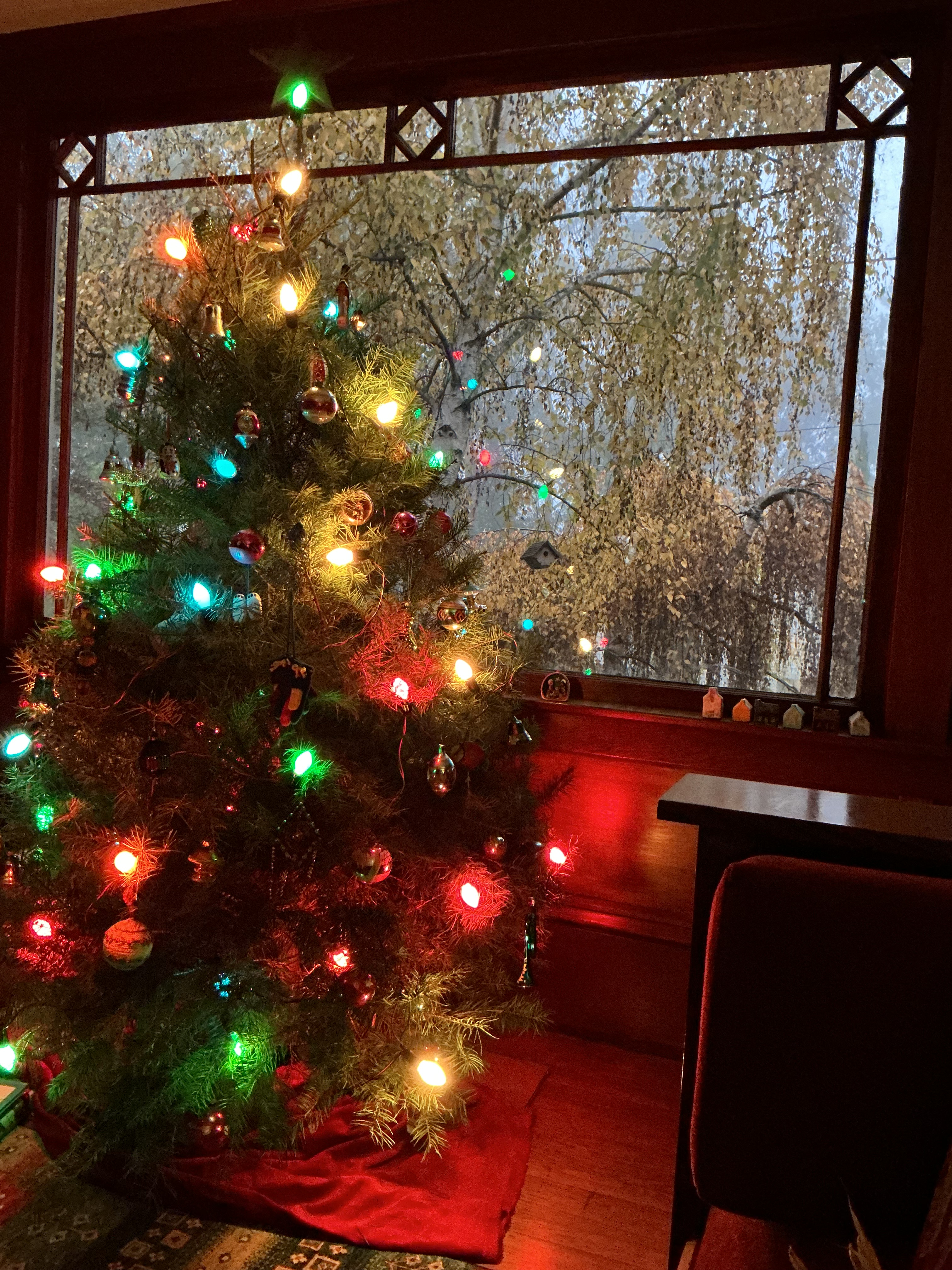
I have a memory of my childhood that is still a mystery to me. It was Christmas Eve, and I was in bed, in the narrow room I shared with my little sister, Suzie. Maybe she was already asleep. My bed was pushed up against the wall with the window. I could hear Mom and Dad in the living room, only a few feet away, shuffling around, making things happen. Like tradition in the Old Country, they were decorating the Christmas tree which Suzie and I would only see in all its glory for the first time on Christmas morning. There was always a layer of ice on the second story window, the cold of Milwaukee’s winter coming through the storm window Daddy had carefully hung in autumn. And on that Christmas Eve, I heard the bells – outside my window. I heard the bells of Christmas! I raised my head from the pillow, looked out into the cold, dark winter night. The only sound I heard then was the rustling of my parents in the next room.
The magic was gone. As quickly as it had arrived – gone.
And I fell asleep then in anticipation of Christmas morning, when, in the old European way, we would open our gifts around the decorated tree, the gifts that had arrived – mysteriously – sometime in the night.
Magic! photo by Mary Elyn Bahlert, 12/2025, View Place
When I was growing up in Milwaukee in the 1950’s and 1960’s, the Christian holidays were honored culturally. We sang Christmas Carols during December at school. We had the week following Easter off – always – as spring break – whether or not the weather honored the season. And although my family were not church-going people, we celebrated the Christian festivals along with everyone else.
For weeks before Holy Week, Mom carefully decorated pysanky, the Ukrainian decorated Easter eggs. I had the job of blowing out the eggs before Mom sat at the kitchen table and carefully applied wax and coloring to the empty shells.
I was still small – maybe 6 or 7 – when Mom told me that a man had been hung on a cross to die. The streets were quiet that Good Friday – stores were closed to honor the somber day – when she let me go out to play on the front steps of the flat on Ring Street, alone. I ran up and down the steps. My instructions were to stay in front of house. And as I played alone on the steps, I wondered about that man who had been left on a cross to die. I thought he was somewhere not far away, but out of my hearing, in the quiet city.
Part of me was taken with the story, which in later years I would tell, again and again, to congregations in California, a long way from those narrow, bleak streets. I imagined the man into existence, in a way: captivated, wondering.
On Easter Day, Grandma Markowski would be making her way up the alley to our house, and we’d try to tap each other’s eggs colorful eggs – not pysanky, but regular decorated, hard-boiled eggs – to see whose egg didn’t break. They were the winner!
Later, Auntie Anne and Uncle Harvey, Mark, Patty, and Johnny would arrive for the dinner, ham and all the trimmings. Later still, the women would go into the kitchen to talk and talk as they washed and dried the dishes, while the men sat together in the living room, drinking beer, and waiting for the holiday table to be cleared so that the Sheepshead playing could begin.
Soon enough, Easter was over, and soon enough, the well decorated, hollow eggs that had been carefully decorated and displayed, were set aside, to come out another year. This year, like all the rest, a dish of the beautifully decorated eggs will grace my table, just as they did Mom’s table.
Pysanki by Mary Bahlert (Mom), Jeff Kunkel, Ronn Lass
The holiday season is quickly approaching, the end of the year when the season of lights – that time when darkness slowly darkens and gives way to the light at the winter solstice – arrives, day by day. In the Bay Area, I often have to work hard to give myself a winter-cozy experience in this season. But this year, the heavens are in tune with the season, days of rain welcoming us to the longer nights.
When I sat to write this piece, I was thinking that I am not one given to focusing on giving thanks. Over the years, I’ve studied with healers and shamans, and teachers of all kinds – many of whom would say that a grateful heart, a grateful attitude, is a good thing. Necessary, even. But in my own temperamental way, giving thanks does not come easily. If I’m to fill the journals I’ve started over the years (Oprah says that if I write down 5 things I’m grateful for every single day, my life will change…), I’ll have to be more disciplined about the practice of giving thanks. All change begins with practice, in my experience. Practice, practice, practice.
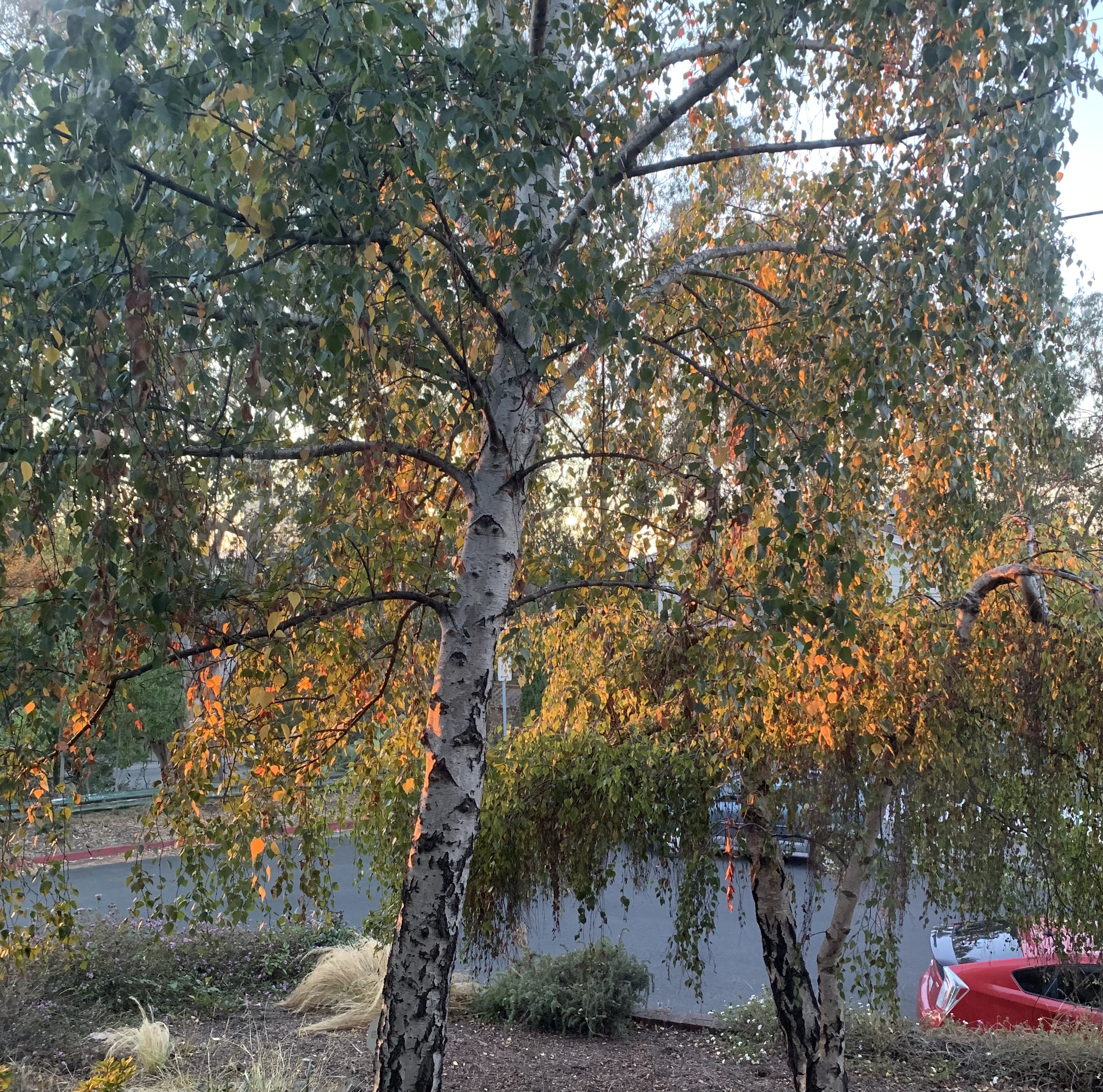
But today I’m grateful for the beautiful tree that accompanies me here in the house on View Place – the birch has been a faithful companion as long as I’ve lived here, and I’m grateful for a cozy house as the season of holidays approaches. A quiet house, a place of comfort in a world that is often crazy-making. Today we’ll welcome a 4 year old and her parents to join us for a week, and the house will not be quiet, but filled with laughter and fun – and tears, I’m sure. The cat has taken to sitting with me on the sofa where I have my morning coffee and chat with Jeff. She seems to live a grateful life.
On Thanksgiving Day, we’ll join a bunch of Bahlerts at their little house on Potrero Hill in San Francisco, where the sound of little ones running past us will fill us up as much as the lavish meal. I’ll bring the pies: cherry – two this year, by special request – apple, and pumpkin. I remembered to buy whipped cream before the store runs out.
And if I remember, if I stop all the busy-ness that’s inside of me for a few moments, I can be grateful, too, in honor of the holiday.
Happy Thanksgiving week, everyone!
Photo by Mary Elyn Bahlert, View Place, November, 2024
Some people have uncles that were awful people, creepy people, uncles that no one liked, uncles that were hard to be around.
Not me. I had wonderful uncles, and I remember them, along with all the rest of the ancestors, often. While they did not say it – ever – I knew that there was love, or at least affection, in them for me.
Uncle Pete, my mother’s youngest brother, was full of himself. Like all the others who are full of themselves, he took up all the space in a room. He had a large presence, a sort of charisma, I suppose. His dark eyes danced as if he had a joke to tell. He could tell stories from three wars – “Pete fought in three wars,” the men in his neigborhood said as they made room for his wandering, his memory loss, in his later years. Pete, my handsome uncle Pete, who walked silently to the car with me on a visit I made to the military hospital in Oakland to see Aunt Athalie, his wife. Then, he seemed shy even, as he carefully saw that I was in my car and had driven safely off.
Sometimes as I got older, he’d ask me a question he should have asked my mother; “ask my Mom,” I’d say, without saying more. He didn’t press me further. Did he ask my Mom? I don’t think so! Like many families, differences were not worked out directly between the siblings. They had to trust in the passage of time to take away old hurts.
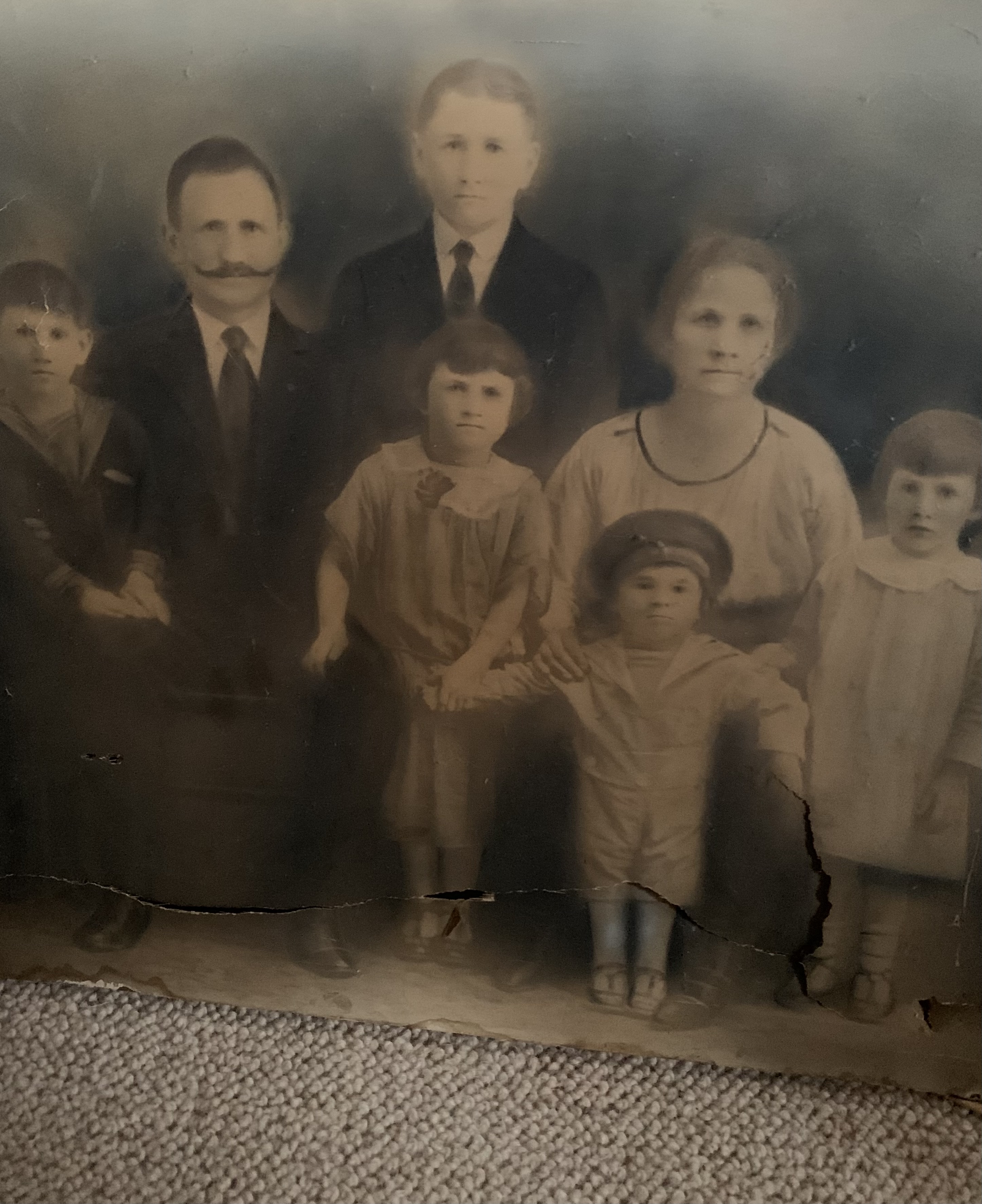
Uncle Johnny was the eldest brother, a hero to my mother and her other siblings, Mike, Anne, Pete. He was older than the next one in line – Mike – by 9 years, and it was safe to say that he had been born in the Old Country, Ukraine, although the family lore held that he was “born on the boat.” When he went off to work, he showed up at home to bring Christmas to his siblings, knowing that his folks would not come through for them – ever.
Uncle Johnny was smart, well-read, an atheist: an uneducated intellectual, the condominium he shared with Aunt Dani filled with piles of magazines and books. His brother’s eyes were full of pride when Johnny spoke; my mother’s, too. He was a quiet one – like Mike and my mother, to Anne’s, to Pete’s extraversion. In his later working years as a machinist, he was a union man, his democratic socialist leanings lived out in his own life. He was our hero, too.
Uncle Mike was so quiet, so much part of the background that I have few memories of him. Did he ever speak to me? He married Alice, a British woman he’d met when he was a motorcycle-riding soldier in England during the War. When I was a young woman, Alice would call me from time to time, and she’d take me to dinner, where she talked and talked. After Mike died, Alice finally got a phone for their little home in a town north of Milwaukee. I last talked to Alice when she happened to call my mother in the days before we moved Mom to live out close to us in the Bay Area. My mother’s memory was already poor, so when my Aunt Alice identified herself to Mom, she handed the phone to me, probably thinking the call was for me.
**
Dad was one of nine siblings, one of only two who’d left Door County, Wisconsin, to live in the city; Dad settled in Milwaukee, Uncle Norman, his youngest brother, in Queens, New York, where he worked as a police officer. And so I had a string of aunts and uncles on the Bahlert side.
Clarence and Ray were Dad’s older brothers, Ray, a farmer, Clarence, a retired Coast Guard officer who worked the wild waters of Lake Michigan, all the way north to Washington Island, off the tip of Door County. When we stopped at Clarence’s house in Baileys Harbor – a cottage close to the shore of Lake Michigan – my Dad and Clarence stood outside talking for a long time, two brothers, separated by time and distance, by different lives.
We stood on the grass outside of Ray’s house, too, Ray, a quiet man – “one of the quiet Bahlerts,” with a quiet wife and a quiet daughter, my cousin Terri. By the time I remembered seeing Ray and his place, my cousin Roger, Terri’s elder brother, was married and gone, with a daughter of his own. Not until years later did I come to know Roger, after I’d retired. After a time of talking – my Dad did the talking, Ray the listening (I’m sure) – we’d walk around to the back of the property, to see the raspberry bushes, to taste a few, and to take a quick look at the outhouse, still in use, on the property. My family in northern Wisconsin were rural people, kind, gentle people. I loved them – love them – for that.
My dad told us a story about Ray and him, the two of them riding a Model T down the Sister Bay Hill that wound right down and into the main street of Sister Bay, on the Green Bay side of the peninsula. Young men, they yelled “Betsy Ross!” – a slang of the day, as they started down the hill, and as the driver shouted, he pulled the steering wheel right out of the steering column and held it high in the air until he realized what was happening, then poked that steering wheel right back where it belonged, and continue to navigate down the long Sister Bay Hill! Every time I go down that hill now, I think of them on that day, and I think of my father’s face, his voice rising, as he told the story – as he’d lived to tell the story.
Uncle Fritz was next in line, younger than my father. He was Dad to my cousin Bobbie, like Terri, a bit younger than me. Like the rest of the Bahlerts, Fritz was a worker, coming home from a day in the shipyards in Sturgeon Bay to butcher at the store he and Aunt Goldie operated near the north point of the Door County Peninsula. The only time I went as fast as 100 miles an hour in a car, I sat with Bobbie in the front bench seat of my uncle’s pickup, watching that speedometer go faster and faster! Fritz was quiet, too, and I don’t remember a conversation with him, although he was closest in age to my Dad.
Uncle Norman, the youngest, married a woman from the East Coast and raised his family there. My only memory of Uncle Norman was when he stayed with us overnight on the way to Door County to see his mother, my Grandma Bahlert, in the days before her death. I was a little girl, and I watched with big eyes as my handsome Uncle Norman came into the kitchen. Every year at Thanksgiving now, Jeff and I celebrate the holiday by sitting around the table with Uncle Norman’s eldest son, Norman Bahlert, and his family – children and even grandchildren now, and Cheryl, Norman’s wife. Pictures of the Bahlert’s from generations past look down on us all, seated around the long table, as if guarding their progeny.
So these were the uncles, distinct, kind, a part of the framework of family who peopled my life, then – and even now.
Vlas Markowski (Srebny) with Mike to his right, Johnny standing behind, and Pete, the little boy with the hat, at his mother’s knees. Photo, circa 1921-1922, Milwaukee, WI.