Uncategorized

Four Rules for Living, #2, Pay Attention

Show up. Pay attention. Tell the truth. Don’t be attached to the outcome.
FullSizeRender

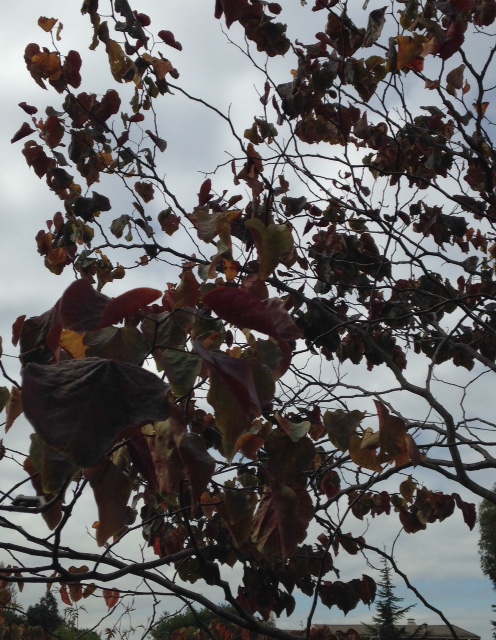
(pay attention to the passing moments of this season, summer becomes autumn…)

Pay Attention

Pay attention means “pay attention” to what is. To “pay attention” is to see things for what they are, without judgment. Someone new or something new –  may signal something wrong – or not.  Someone missing may mean something is wrong – or not.  A change in the way things work may mean something is wrong – or not.  “Pay attention” means only that: to see what is there, to give your life active attention – to what is, without categorizing it as “good,” or “bad,” but as it is.

Our minds fall easily into the trap of seeing what is “right” or “wrong.” Both are sides of the same coin. If we have done the work to “show up,” then the natural outcome will be that we are able to “pay attention.”

See what’s there! Notice!  Observe your life, your surroundings, from moment to moment.

Surely this is easier said than done, for all of us.

***

I love confession scenes – in books, in the movies.  One of my favorite confession scenes takes place in the movie, “Moonstruck.”  Cher plays a young woman who becomes infatuated with the brother of the man she is engaged to marry.   After a lovely date with said brother, Cher awakes to find herself in his bed.  Still engaged to his elder brother, she promptly goes to confession.  Although she sits behind the traditional barrier between herself and the priest, both she and the priest know that this priest has known her for her whole life; he is her parish priest.

The young woman begins her confession, naming a list of everyday happenings, like “talking back to her mother.”  She speaks as quickly as she can, and she makes sure she throws into the mix of sins, “I slept with the brother of my fiance.”  She rapidly continues, not stopping for breath.  But the priest has been paying attention!  He returns to that hidden sin!

Then, he says, simply and with kindness:  “Reflect on your life.”

The priest’s own attention turns the young woman’s attention back on what needs to be attended to in life.  Pay attention! – he could have said.  What are you doing?  What does this mean about your life, about who you love – and don’t love?  “Pay attention!!!!”  Stop what you are doing long enough to  pay attention to what it is you are doing.

***

“Pay attention” is not simply another rule for living.  To pay attention may be at the heart of what is needed, now, for your life, for my life, for the life of the world.  “Pay attention!” we say to our lawmakers.  “Pay attention!” we say to our leaders, our friends, and – most whole-heartedly – to ourselves.

One of my neighbors works all the time. I never see him. He’s got important work, I know. But as far as being a neighbor – well, he’s hasn’t shown up for a long time! When an ambulance drives, siren shouting, in the neighborhood, others “show up” to “pay attention” to what is happening. Which home is the ambulance for? Is there something that can be done for the folks in that home? Who will talk to the paramedics to see if someone can be called?  How can my neighbor pay attention if he is preoccupied with “life,”- with important things – and if he cannot even show up?

How can I do this?  Or you?  Or any one of us?

And so it follows:  show up – pay attention.  (Simple, but not easy… another practice for our spirit…)


Uncategorized

Four Rules for Living, #1: Show Up

The anthropologist and spiritual teacher, Angeles Arrien is credited with these 4 rules for living:  Show up.  Pay attention.  Tell the truth.  Don’t be attached to the outcome.

Show Up

It’s easy to show up if you think it means you only have to be present in body. Yes, that’s easy. We do it all the time when we’re preoccupied with family issues at work, or when we wake up in the middle of the night thinking about a conversation we had the day before. We’re there “in body,” but we’re not really “there,” we haven’t really “shown up,” for our work or for ourselves.

Show up. Be present. Be there, now! See what’s in front of you. Feel what you feel. Show up for yourself in order to show up for others.

How do you “show up” for yourself? My first thought is that this takes work. “Showing up” means letting go of everything that isn’t working for you now. For example, how often do you react to someone else the way you reacted to your mother or father when you were 5 years old?

Are you working too hard in order to not pay attention to the nagging feeling you have about life?  Do you still live by the rules you were taught as a child, without ever questioning whether those “rules” are valid for you, for your life, for your times?  Are you drinking too much, or even every day? Are you letting your health go?  Are you too busy to connect with others?

The real work of life is to learn to let go of those things that don’t serve you now, and haven’t served you for a long time. If you’re preoccupied most of the time, then you have work to do. Maybe you need to talk to a trusted friend about what’s troubling you. Maybe you would be helped by talking to a therapist. Maybe you need to take some time alone to get back in touch with yourself and your own needs. Maybe you need to get up and move a bit!

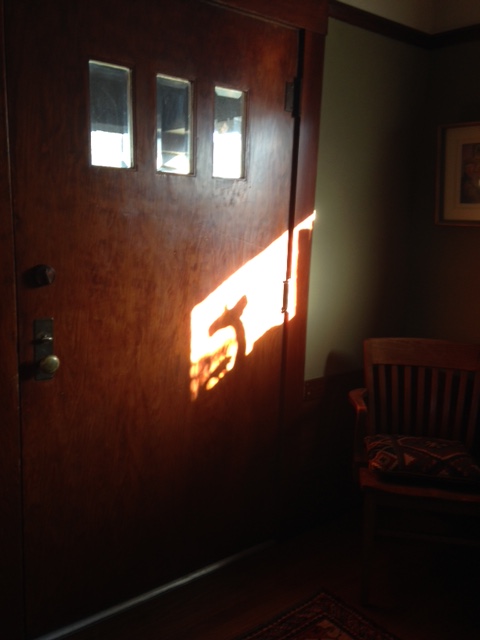
Show up for yourself.  Breathe.  Notice your surroundings.  Notice how the light falls on the walls  of your room.  Notice how the light changes.  See what is outside your window.  Show up for this moment, show up for your surroundings.

Show up. The world needs some folks who are adults, who respond to life and its ordinary emergencies with clarity and presence. If you haven’t done the work, then our world needs you to do the work. None of us is perfect, but we all have work to do in order to “let go of childish ways,” to take on the ways of being an adult.

One of the important practices of life is to show up. I remember keenly – and with great fondness – those friends who have been there when there has been a loss in my family. I remember a good friend walking with me from my mother’s grave on the day of her burial – in the Midwest, in February – telling me that I had a wonderful family. I will not forget that my friend had shown up, nor will I forget that she shows up – again and again.

Moments like that one at my mother’s grave are the moments that remind me to show up. For me, to show up is a kind of practice, a way of being an adult, a true act of presence.

Are you showing up? Are you present when something important happens? Are you present for the important people in your life when they need you? Are you present when a transition, a turning point is being celebrated?

And, deeper:   when you show up, are you really, really there???!


Uncategorized

“Houseplants,” a poem by Mary Elyn Bahlert

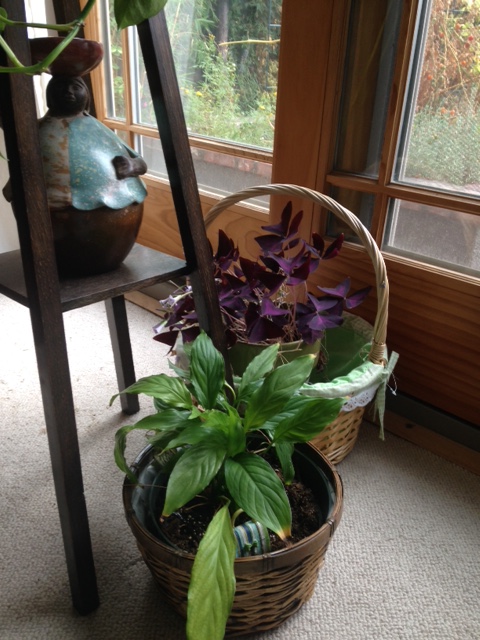
IMG_0525My little friends,
yellow and brown and purple and green,
I treasure you,
my hands among your leaves,
my fingers at your roots.

My little friends,
there is so little I am good at in this world:
my children want for what they cannot have –
I have only these hands among your leaves
and a few places of sunlight in the house.

My little friends,
my eyes drop tear-less on your stalks;
I protect you from the cold in this place.
I touch you with these worthless hands
and you flourish.

+++

I wrote “Houseplants”  as part of a series of poems that belong to my grandmother, Feodosia.  For these poems are the story of her life, told through me over the course of a year or two in the late 1980’s.  Surely our connection to the ancestors goes deeper than we know – or than we are taught to cherish, in our culture.  The magic my Grandma – a bent-over babushka in a long black coat walking through the slush of Milwaukee’s narrow alleys – must surely have come through me, the magic of our connection told through the words I recorded.

Enjoy.

Uncategorized

Nothing Is More Practical

Nothing is more practical
than finding God,
that is,
falling in love in a quite
absolute and finite way.
What you are in love with,
what seizes your imagination
will affect everything.
It will decide what will get you out of bed
in the morning,
what you will do with your evenings,
how you will spend your weekends,
what you read,
who you know,
what breaks your heart
and what amazes you with joy and gratitude.
Fall in love.
Stay in love.
And it will decide everything.

Pedro Arrupe SJ,

From Finding God in All Things: A Marquette Prayer Book © 2009 Marquette University Press.
Uncategorized

“Time passes much too quickly, when we’re together laughing…” Chicago, “Beginnings

IMG_0515

When I was a girl, my father would say from time to time: “my life has gone by so quickly.” I would look at him, just little, and wonder what he meant, and how that could be. I could not relate. Some people say that time goes more slowly for the young, when all the years stretch out beyond, when growing up is something to be yearned for and in the yearning, of course, time passes slowly. But my memory is of that question or wondering that was in me when I heard my father reflect. Later, he would quote again and again, this verse: “A thousand years is but a day in the eyes of the Lord.” Apparently, my beloved dad did not stop thinking about the passage of time.

Just last evening, I was telling a new friend about some of the favorite days of my life.  Those days were on my visits to Milwaukee to see my mother, after I had moved to the Bay Area of California.  My mother lived in a small upper floor apartment on a busy street close to the center of Milwaukee, and I would stay in the cramped second bedroom, the noise of the busy thoroughfare keeping me awake nights.

Both mom and I were “Milwaukee girls.”  We had grown up in the flats that line the streets of poor and working class neighborhoods of the North Side.  Those flats are there, still.

We knew the streets, the bus lines, the parks, and we knew the sense of small town-ness that Milwaukee cherished for a long time.  We knew the particular kind of diversity of that place – the streets where Eastern European communities lived, the place where the Italians built their church, now a Cathedral to welcome the Bishop from Rome.  We knew the part of town where people from Mexico came to live among others who spoke their native language.  We knew how to navigate to new places, too, in that city laid out in a grid.  I have never understood how to find new places in new places, new cities.  How can addresses not make sense, like they do in Chicago and Milwaukee, a small Chicago?

On my visits to see Mom, before the dementia took her away from me, we set aside a day to “do Milwaukee.”  After coffee and breakfast, we backed her car out of the garage and onto the busy street.   We had no particular plan, except to explore some new places, to make our way to the Milwaukee Art Center at some point, to have lunch out, and maybe to do a bit of shopping along the way.  I loved those small adventures.  I loved the fun we had together:  “that’s the fun of it!” was one of my mother’s expressions.

On one adventure, we discovered again a small section of town filled with Ukrainian immigrants.  My mother’s first language was Ukrainian, and so we ventured into a small bakery, a store-front, and she stumbled to say a few words to the man behind the counter.  He understood, all right, and soon we found ourselves in another cramped space, the family’s living room, complete with an altar adorning a corner.  They were Ukrainian Catholics, and a candle burned in that corner, lighting up the features of the Virgin Mary, her eyes cast down, her blue gown ending at her bare feet, on a sphere covered with stars.

On another adventure, I gazed at my mother as she gazed at one of her favorite paintings in the Milwaukee Art Museum, The Wood Gatherer, by Jules Bastien-Lepage.  Later, Mom told me her wonderings about the scene that painting depicted, her own story fleshing out the art.   I still own a print of that painting.

One day at lunch we found ourselves in an old Italian neighborhood for an Italian lunch, another at a Jewish deli across from a synagogue.

As the years passed, it was harder and harder for mom to enjoy those days, until the last time we set out.  Of course, we did not know it was the last time, but something had changed.  We returned home to her apartment right after lunch.  Soon enough, I’d have to move Mom out of her apartment and into assisted living in the Bay Area, a move which she made bravely and with great trust.

I suppose some part of me thought those adventures would go on forever, that those times when we laughed and remembered and noticed would not end.  But all times end.  Now, those days are distant memories, and I continue to cherish them as some of my favorite times.

Here, I find myself years later, remembering those small adventures, remembering the tilt of Mom’s head as she laughed, remembering the narrow streets we knew so well, remembering driving her blue Tercel all over the city we loved.  I’m in the memory time for so many people I have loved, so many experiences, so many grievances that had filled my life over the years.    All of those beloved people, all of those rich days are a memory, now.