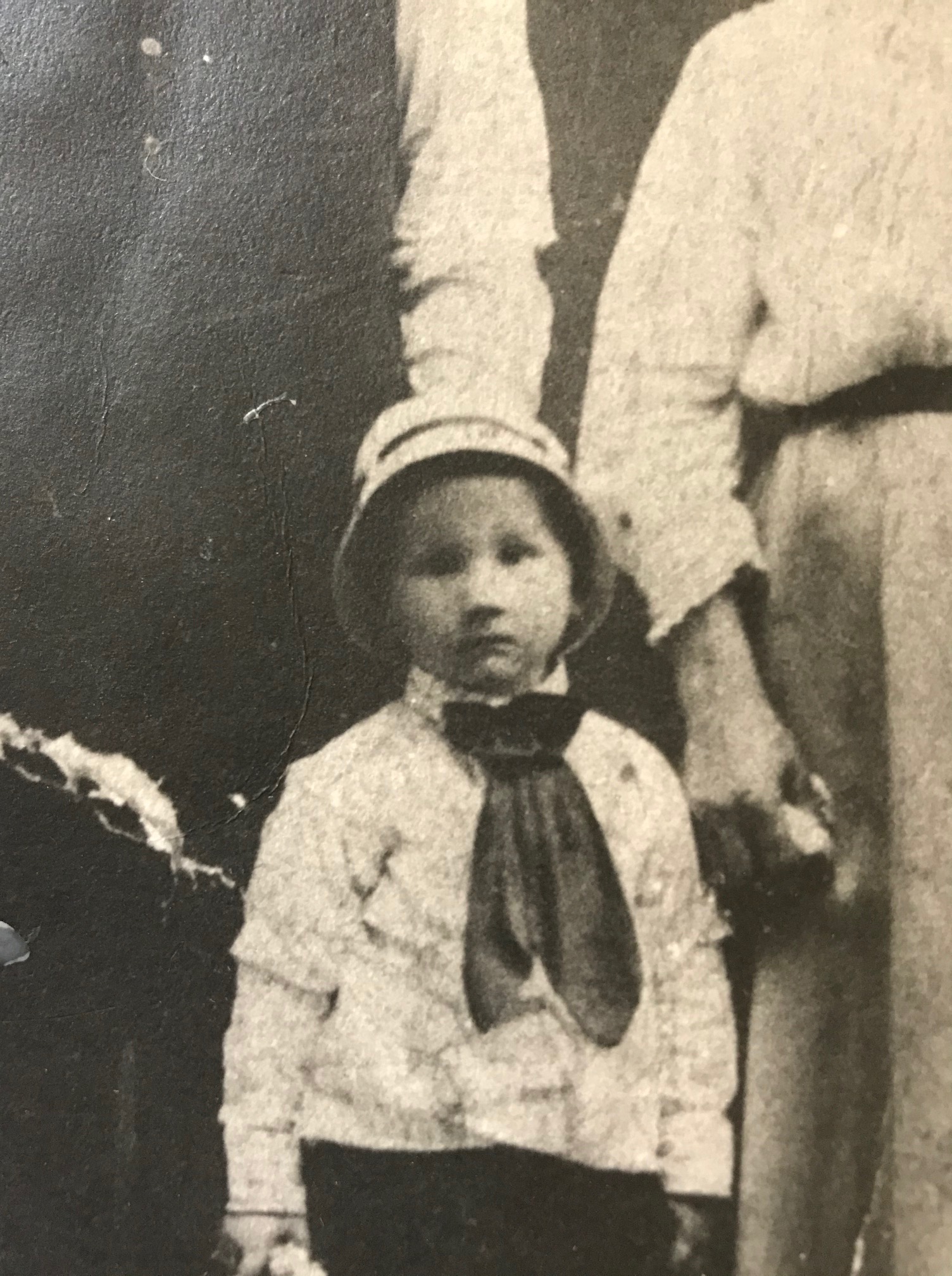
Jeff and I weren’t kids when we married. We were both over 30, well on to our adult lives, when we were married in that spring snow storm – March 21 – in Milwaukee. People in Wisconsin are not deterred by the snow; the church was full on that evening, regardless of the weather.
But like most couples (I suspect), we had to make our way slowly from being two headstrong, smart and heady individuals, to being a couple. Oh! the places we will go – and the emotions we will go through! Or maybe it’s easier for other couples.
Both Jeff and I remember the first time we knew for sure we “two had become one.” It took awhile. Well, it took several years. We had moved into the beautiful Craftsman home in Oakland that we have called home since. We were proud of our home then, and we’re even more proud of our home now. We’d moved most of our furniture into the house, and everything was beautiful – to us. But we wanted a Craftsman style sofa to match the rest of the wood in the house – wood which (we are proud to say) no one has ever painted over. We discovered a business in Berkeley that sells Craftsman furniture exclusively, and we’d picked out the right sofa for our space. It was time to choose the fabric.
At the time, Oakland had a wonderful – wonderful – fabric store that has since closed. Many years later, folks who live in Oakland still remember Poppy Fabrics. So Jeff and I went off to Poppy Fabrics one afternoon to pick out the perfect fabric for our new sofa. We were methodical. We found the upholstery fabric and began at the left side of the aisle to look at one fabric after another. Then, we started up the aisle again.
And that’s when we knew. I stood to Jeff’s right as he moved the fabric rolls from side to side. And as he touched each fabric, and we looked at each fabric together for a few seconds, Jeff said: “Do we like it?“
“Do we like it?” That must have been a new experience, because we both noticed. I laughed when I heard him say it. Jeff looked around, surprised (but happy – he loves to make me laugh). We were a couple!
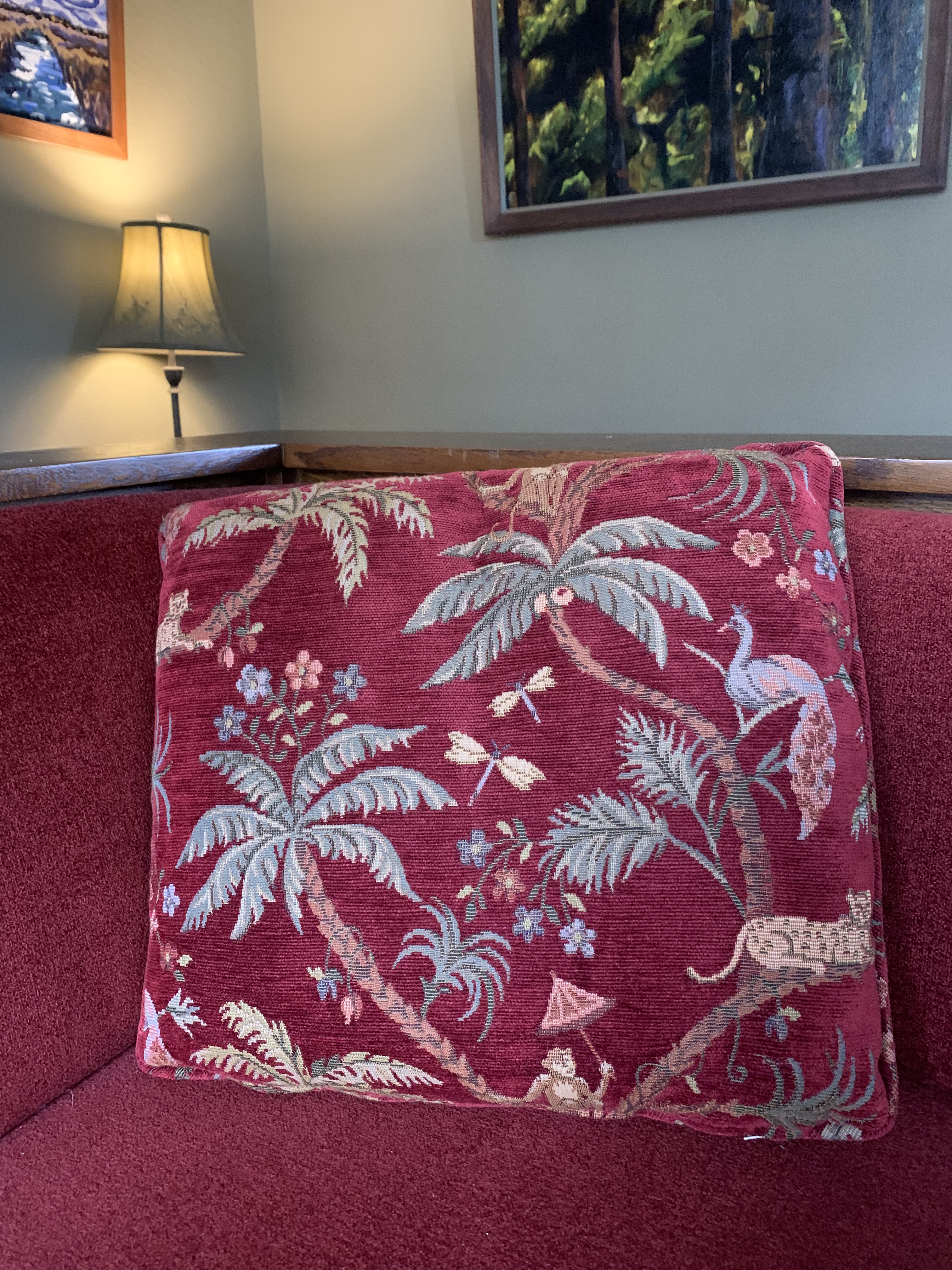
The fabric that proved that we had moved from “I” to “we”. Just the right colors. Photo by meb, 3/2/2026
“Curiosity killed the cat…” hmmm… that may be true. And although it may be true, it is also true that curiosity is a curious and important quality. Some people are curious, others are not. Maybe that’s one way the world is divided into “us” and “them.” For some, each day holds some curiosity… a new view of an old street, or seeing something one has not seen before. When we are curious, the world opens itself to us, shining full of curious things – and happenings.
As I reflect on my life in my elder years, I often return in memory to my Junior High years. I walked from our rented flat in a working class neighborhood of Milwaukee – I actually passed the Master Lock Company – on Fond du Lac Avenue, into the middle class neighborhood that surrounded Peckham Junior High School. At Robert M. LaFollette School and later at Clarke Street School on Milwaukee’s North Side, my classmates were also the children of factory workers and stay at home moms. But Peckham Junior High was in a lovely north side neighborhood with single family homes and carefully kept lawns. My world grew as I walked under the viaduct at 35th Street. I was a young person with open eyes and a keen interest in the world, a quality shared by my family. Right away, I noticed the differences in the neighborhood where Peckham J.H. stood, comparing what I saw in some deep, unspoken part of myself.
I was curious and I was smart, both qualities that have served me well in life. I had role models. At home, my parents listened to the news each morning from the radio that sat on top of the refrigerator in the kitchen. And they stayed up at night to watch the news at 10 o’clock, before they went to bed to get enough sleep before the alarm in their bedroom went off at 6 am. They read the daily newspaper – The Milwaukee Journal. Many years later, on the cold February day in 2001 that my mother was buried alongside my dad at their gravesite on the south side of Milwaukee, I walked away from the grave as my good friend Vickie walked alongside me in the cold. “You had neat parents,” she said.
I think curiosity is one quality that my parents had that made them “neat parents.” They were interested, not only in the world, but in my friends. And when Vicki lost her mother at a young age, they were particularly welcoming to her whenever she came to spend time with me.
The world can be a difficult place – often. We are assured of that by staying in touch with the news every day, as my parents did. As adults, they knew the pitfalls of life along with the kindness and goodness. The world can be a difficult place. But the world is endlessly interesting.
I was thinking about curiosity today when I was preaching about Nicodemus. Nicodemus, best known for visiting Jesus at night to discuss spiritual rebirth and later assisting with Jesus’ burial, had a journey from hidden curiosity to becoming a follower of Jesus. Nicodemus came at night to talk to Jesus, apparently curious himself about this man who was causing a stir as crowds followed him from place to place, eager to hear a good word, or eager to be healed.
I told the story of a time my big brother Ronn, who married in his early 20’s, came to me after his marriage and made a comment I have not forgotten. In a way, Ronn had always treated me as an equal, although he was 9 years older than me. And I’ve never forgotten what he said: “did you know that not everyone is interested in things, like our family is?” I understood then that he was reflecting on a difference he had noticed in his new wife’s family. He didn’t say more. I always loved Sue – love her still now that she’s been gone many years – but it is true, she did not have the interest in life that Ronn carried, as if he was carrying a gene that gave him a keen interest in learning, in new things. Later, he’d turn that interest to computers, and when I called him from across the country with a problem using my first computer at home, he’d patiently walk me through the steps I needed to get back on track.
And I suppose, like Nicodemus, curiosity might lead us into unknown, uncharted places. Maybe curiosity is responsible for whatever risks we take, a companion to the risk.
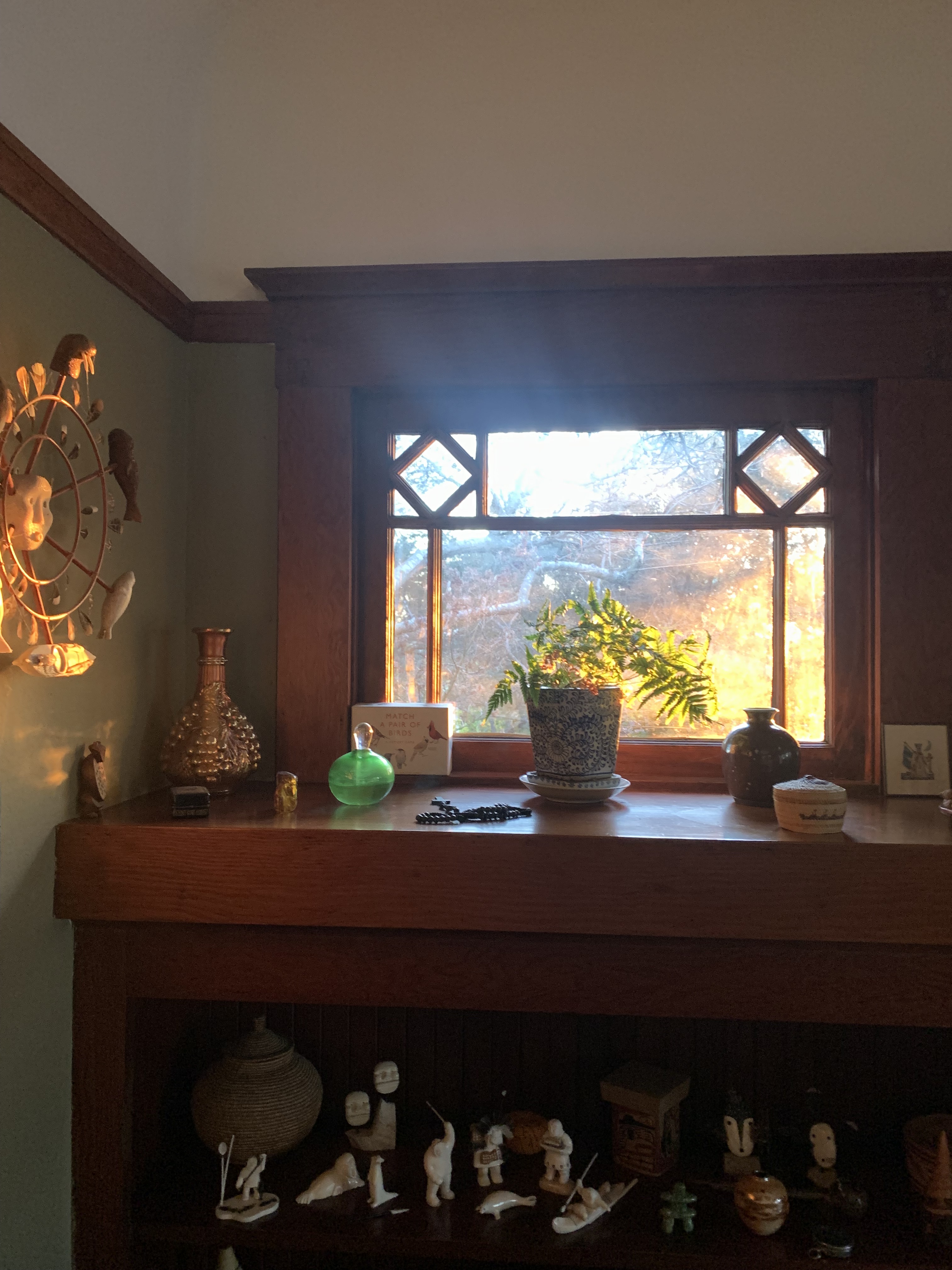
The world is endlessly interesting… even the small places are beautiful… photo by Mary Elyn Bahlert, 2/2026
At my retirement gathering, to honor my retirement from active ministry, a woman I went to seminary with and who had retired several years before I retired, told me that after she retired, she felt as if she had lost God for a while. I was surprised at her comment. I didn’t think I would experience the same thing. At the time, I “prayed at all times” by having an on-going conversation with Jesus.
But I was wrong. For a couple of years after I retired in 2014, I felt as if I was adrift in my spiritual life/journey. As time has unfolded, I have returned to my relationship to the Holy, in a new/different way than before.
Now, I have the sense of my being “in” God, as part of God, not separate. I am immersed in God’s presence, as I am immersed in the air, say. The relationship I have now – as I compare my “before” and “after” – is to be part of the Whole. And ‘the Whole” is abundantly huge, “the Whole” is all that is. “The Whole” is loving all of creation and all that is beyond within itself. What that means, I can’t say/explain to myself. I don’t try. My time of prayer now is simply being with awareness, when I have that awareness. Often, my time spent walking is a time for me to be in that presence –
“You will wonder and in the depths of wonder you will discover a simpler way: you will walk, feet planted firmly on the earth, head up. You will walk into that sighing Presence.” – from the Collection, “Moments,” Mary Elyn Bahlert, 2026.
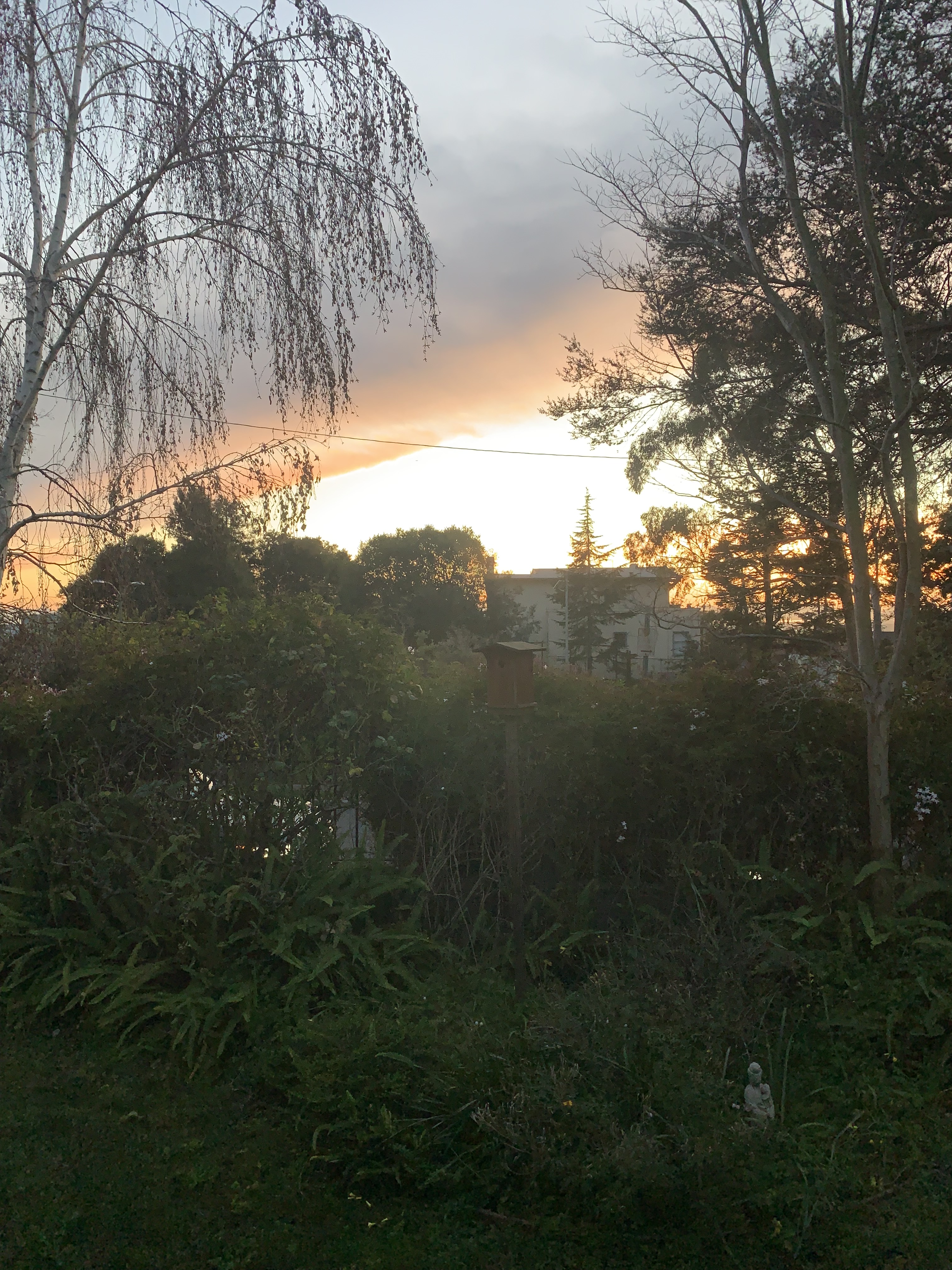
“You will walk into that sighing Presence…” – photo, Mary Elyn Bahlert, 1/2026
When I was a young teenager, I began to long for the days when I would be 17. I had a “calling” to 17. Of course, 17 came and went, and my life went on and on until I am writing to you now, from the wisdom years, the elder years.
When I walk down the street now – and I walk often in my “walkable” neighborhood in Oakland – I know that I am a senior citizen: one young woman, pushing to get past me in a parking lot walkway, called me: “granny.” OK. I’m old now, or elderly, or “getting on in years,” as my Dad used to say. Jeff once heard the couple next door – overheard them over the tall fence that separates our yards – tell a friend that there was a “nice older couple” next door.
But I know that I’m stuck at 17 – inside. I’ve done the work: years of therapy, growing pains, coming to terms with my family of origin, self-help groups, classes in personal growth. I’ve done all that; maybe I’ve done too much of “that.” So I’ve done the work I needed to do to become an adult. I’m grateful for the work I had in life that required me to grow, to always grow, to look deeper into myself to find who I am. I’m truly grateful.
And I’m still 17.
Many years ago, I gathered a group of women to a meeting room in the church where I was Pastor, to see our way forward to begin a new women’s ministry. I started the group by asking everyone to think about how old they were inside. Around the table we went, listening to one another’s answers, nodding at what we heard. An “older” woman – probably about the age I am today – said: “I’m 18.” She looked at me. I looked at her. Yes, I thought, she is 18. I’d found a friend!
Sometimes now when I’m with friends, I wonder how old they think they are – inside. Through the years, I’ve asked. And the answers they have given resonate with who they are to me.
I haven’t asked him, but my husband is older than I am, by a few years. I know he thinks, probably even knows, that he isn’t, but he is. He’s in his late twenties. And I’m 17 – although I might not look it!
How old are you – inside?
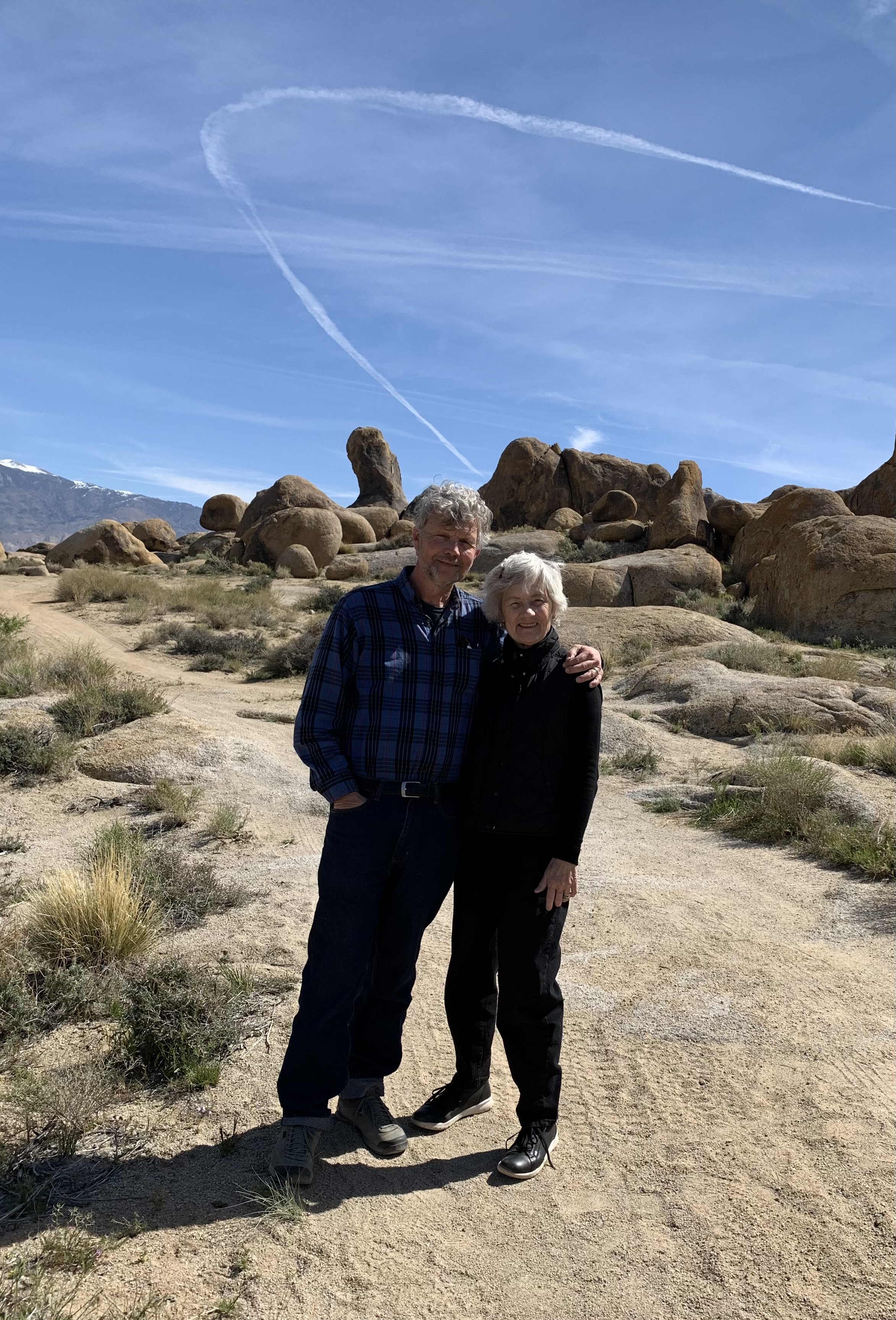
Jeff and Me at the Alabama Hills, Lone Pine, California, April, 2024
Uncle Johnny wasn’t very tall, but he was a god to us. He could stand at attention in a doorway for hours, talking about the workers, about union wages and strikes, about strikes and collective bargaining. He was an Atheist. He greatly respected my father, who had gone through 8th grade in rural schools, because my father was a good, strong, honest worker, a union man, a steelworker.
Johnny was a Communist, giving his own life, his smarts, to make life better for the workers.
Uncle Johnny was almost ten years older than my mother, who adored her brother. He had “been born on the boat,” we were told, coming with his father and mother – my grandparents – from Ukraine, about 1914. Years later, I discovered that his date of birth was in the year 1910; given that date, he had been born in Ukraine. To this day, I hold firmly to the understanding that people who leave their homeland for life in a distant land do what they must to keep their families together. I know mine did. My people were poor and uneducated, the grandchildren of freed serfs. My grandfather died when I was almost 2, falling to the curb on a Milwaukee street, drunk again. Still, he’d made it, made it to America to give his kids a life different from his own. My mother taught him to read English when she was in grade school.
When my mother, her two brothers and younger sister, Anne, were small, Johnny was already a worker. With great homage to Johnny, my mother told me that he had made Christmas happen for his siblings one year when my grandparents could not. There was no Christmas tree in that Milwaukee flat, now a boarding house for other men who’d arrived from Ukraine, most without their families. And there was lots of drinking in that house, a fact that has shaded the family ever since. Johnny knew there’d be no Christmas for his brothers and sisters, so he bought a tree and brought it home. Together, the kids decorated it, together, they made Christmas happen, thanks to Johnny. And under the decorated tree lay the gifts big brother had also brought. That made him a hero, forever.
My sister tells me that she was home sick from school the day two men in suits came to the door. That would have been about 1960. Two men in suits – an anomaly in that working-class neighborhood! What Suzie remembers is that Mom lied when the men asked her if she knew where her brother Johnny was. Mom said no. Didn’t Mom always tell us not to lie? A rumor in the family is that Pete, the youngest brother, who fought in three wars in the Army, never rose above the rank of SFC because of Uncle Johnny’s politics.
The family was proud of its politics, proud of its atheism. We were smart people, smart and uneducated, smart people who worked hard, union workers.
*
Sometime around the time I turned 20, I started thinking that the life of a minister might be a good call for me. I don’t know where the idea came from, because, like the rest of my family, I was not a “church person.” Now, I think a lot of people answer the call they receive by choosing a vocation that suits their temperament. The Call is not particular to the Church, although the Church likes to think it is. The year I was confirmed in the Lutheran Church, Missouri Synod, I stopped going to church, because what I heard in that fundamentalist denomination did not jive with what I was already learning from my European-educated school teachers. Besides, I had never heard of a woman minister. And I wouldn’t, for almost a decade. But there it was, the seed of a different life.
I was over 30 when I enrolled in seminary, almost 35 when I was ordained and sent to serve as Associate Pastor at a Church in San Jose, CA. My uncle Johnny and aunt Dani lived in Campbell, West of San Jose, where they had raised their family, my cousins. The autumn after I started work, my parents wanted to visit me, to see Uncle Johnny, and they wanted to see my church, to hear me preach.
You’ve heard it: “he would never darken the door of a church.” That was certainly true for Johnny. But there he was, along with Aunt Dani, my Uncle Pete and Aunt Athalie from South San Francisco, and my proud parents. It would take me several years after that time to get the hang of being a pastor, of whatever that all meant.
When the service was over, the congregation – full of many well-educated and highly regarded members of the community – filed out through the ornate doors, each person stopping to have a moment to tell the pastors a health concern, or about a death in the family. When my parents came through, followed by the uncles and aunts, I expect pride shone on their faces. I don’t remember.
What I remember is what Uncle Johnny said to me that day. “I can see you want to help people.”
With a touch of kindness and a few words, Uncle Johnny delivered the blessing. From people who had nothing came a love for their children, a pride in the young people who followed them. As a pastor, I’ve given blessings, and I’ve received blessings. I’m grateful. Mostly, I’m grateful for the quiet blessing I received from Uncle Johnny that day.