“You do not need to leave your room. Remain sitting at your table and listen. Do not even listen, simply wait, be quiet, still and solitary. The world will freely offer itself to you to be unmasked, it has no choice, it will roll in ecstasy at your feet.” – Franz Kafka
Author: Mary Elyn Bahlert
Share resources
Yesterday I followed another car for about a mile, stopping at stop lights long enough for the logo in block print on the trunk to register with me: “Wheels when you need them.” City-cars are vehicles you can rent for a few hours or a day, only when needed. In some cities, parking is almost impossible for residents, in San Francisco, for example. Car-sharing of any sort is needed, to be sure.
A long time ago, an acquaintance mentioned his idea that tools and other implements could be shared, from neighbor to neighbor. For example, let’s say you need a lawn mower. Maybe one person on your block owns a lawn mower, so you use it when you need it, then return the lawn mower in the condition you received it. Why, my acquaintance asked, did every house on the street need a lawn mower, or a rake, or a bush trimmer? Why, indeed?
A close friend of mine “rents” her car to a friend one day a week. He has a set of keys, arrives at her house before she leaves for work on the regular day, and uses the car for the day to do errands, to take care of business he can’t make happen easily without a car. No, he doesn’t need a car all the time. No, it’s not a problem for my friend to walk to work on the day her car is otherwise in use. She gets to enjoy the mile walk down an interesting street to her office. At the end of the day, her friend fills the tank with gas and returns the car to its usual place in the driveway. Often, the two don’t see each other for weeks at a time.
Share resources. Such a simple idea. Share resources. Something we have not been accustomed to doing, in our consumer-driven, “each person for him/her self” culture. Why not share the resources we can? Deciding how to share resources can be a community decision. Why not have a few folks from the neighborhood over for a cup of tea one evening to share some ideas. “How can we share resources, the resources we already have?” In community, in a group, our ideas build on the ideas of others, and new ideas arise. This is how group-think works!
Maybe you’ve seen pictures or even a movie that portrayed “barn-raising.” Sometimes in the U.K. the day-long event was called a “raising bee.” On a given day, the community came together to build a barn – an essential for rural life, for animals and crops – to use the resources of the whole community. This custom still takes place in Amish and Old Order Mennonite communities in parts of the U.S. In depictions of “barn raisings” I have seen, the men work all day, “raising the barn,” while the women and children buzz around below, the women lifting colorful cloths from baskets filled with abundant food. All day, the men take time from their work to eat the wonderful food. At the end of the day, musicians magically appear to make music, and the worn-out workers, men and women, find second wind to dance into the night. That’s community. That’s sharing resources.
Sometimes it seems that we are people who have lost our creativity, as if we are marching along, all to the same, droning drummer. To share resources will require some creative thinking on our parts. We’ll have to begin to envision our resources and their use differently.
We’ll have to ask one another for help.
Posted in Uncategorized | Leave a comment
A Life of Awe
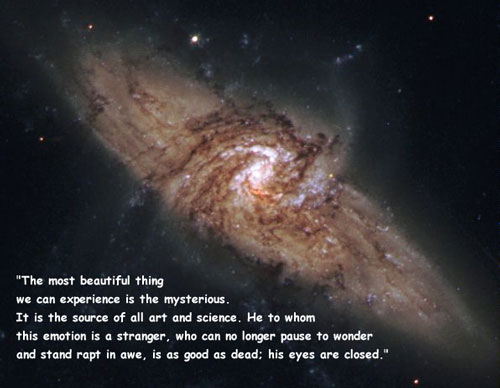
This week, a group of scientists will be meeting at the University of California at Berkeley to talk about their research findings as they have studied “the science of awe.” Through their scientific research, these scientists have determined that spending time in nature is good for human beings; experiencing nature brings us to a sense of awe.
Is that why “awesome” is over-used in the conversation of so many of us these days? For example: “I’ll see you at two o’clock, then.” “Awesome!” That word, “awesome” infects our vocabulary. Listen for it.
Although our ordinary lives may cause us to forget, I think that most of us know the experience of awe when we experience awe! We know – as often as we may be guilty of “over-awe-ing” it – that some moments, some sights, some feelings, some fleeting bit of light brings us to a sense, an experience of awe. For that moment, we are stunned to find ourselves floating in a deep feeling that may over whelm us, with gratitude, with joy, with – awe!
And then, the moment passes.
I am sure that the good people of indigenous cultures knew awe as well as we know awe. While their lives were certainly not easy – one could argue that our lives are not easy, either, although for different reasons – there must have been moments when they were stopped in their tracks by a beautiful sunset, a shining tree, the birth of a baby, the first light of morning on the trees, the sight of their home after a time away. Perhaps they were stunned into awe to witness a healing, to witness a death. And so are we.
Awe = a feeling of reverential respect mixed with fear or wonder, a noun, according the the dictionary on my Apple computer.
Sometimes, life takes your breath away. Sometimes, with tears running down your cheeks, you must completely stop what you are doing to fully savor the present moment, to see your child’s face light up with joy, to watch a deer leap into the woods, to see the light just-so as day passes into dusk.
I don’t need scientists to teach me about awe. I’m sure you don’t, either. The experience of “awe” seems almost primal, so basic to us that we know it when we receive it. And awe does seem to have the element of gift, of being gifted, attached to it. We receive awe, we receive the gift, we are grateful for the gift.
The practice of “awe” can be a deep spiritual practice. Wait, watch, be present every day for the experience of awe. This practice may take some slowing down! Whatever you have on your list to do today, be mindful, watch!, notice that moment that may come when you must simply witness, you must be in awe, that state of presence/joy that stops you for a moment, a wonderful, rich, complete moment you could not have created yourself. It simply is.
And, BTW – have an “awesome” day!
The City of God
“He took me in spirit to a great, high mountain and showed me the holy city coming down out of heaven from God.” Revelations 21:10
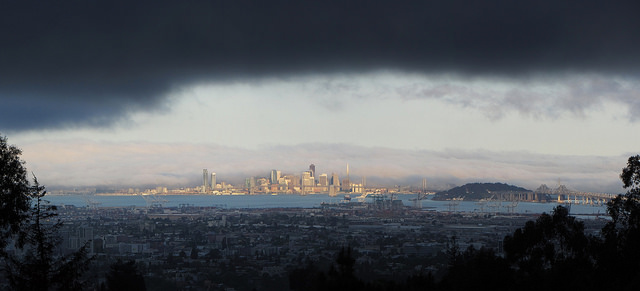
At dusk – when light lowers over the City,
the City sparkles – pink, soft, shining.
From my own kitchen window I witness this one magnificent moment.
I call it the City of God.
That one moment the City sparkles, not grimy, gritty, full of grief,
but beautiful, always, always, always. Then, then –
I am in that mysterious place
between worlds,
where we live – and don’t live.
At once.
The sun drops into the vast Pacific,
lonely place;
the City of God
descends.
meb, 1/2015
Our Little Worlds
We all grow up in Little Worlds, Little Worlds that begin with our families – for better or worse – and gradually expand into the world that surrounds us, that Big World, that foreign place. For some of us, that foreign place intrigues, and so we spend our lives widening and widening the boundaries of the Little World where we began.
For some of us, Big World is a frightening place – which it surely is – and so we use our precious energy to make sure the boundaries of our Little World are never broken. We live within the confining – and supposedly safe – shell of Little World. We take our Little World with us, wherever we go.
Our minds hold our Little Worlds, embrace our Little Worlds, surround our Little Worlds. If we think we have open minds and still, our world does not embrace the wideness of the world and its varieties of thinking and people and ideologies and practices and dresses and rights and wrongs, then our minds are not open at all. We are locked in our Little Worlds, the only worlds our minds can hold. Whenever we think: “how can they be that way?” or “how can they think that way?” we are living within the limits of Little World. That’s how our minds think; that’s what keeps us in Little World. Often our Open Minds are not Open at all, they are only the Little World, unable to give way to Big World.
Experience teaches us – hopefully – that our Little Worlds are not big enough for life. We try to control our Little Worlds, keeping the Big World away; sometimes we are startled awake, startled alive, have our minds broken open. When our minds break open the edges of our Little World gives way to Big World.
Our minds are broken open when our hearts are broken open – by failing, by submitting our privilege, by addiction, by depression, by the truth that whatever rules we learned in the Little World cannot carry us in Big World. Our minds are broken open when we realize we do not know, we cannot know what is right or good for another. We learn that we don’t even know what is right or good for ourselves. We learn that the rules we learned in Little World don’t work in Big World. The rules we learned in Little World are meant to keep us small, and safe. Big World is not safe; Big World is an adventure.
We – those of us who have had our Little Worlds broken, are grateful for those things that have broken us, for they break the Little World. And this, this alone makes the world a safer, kinder, gentler place, for all. Big World is a place of love, of limit-less love.
When Little World is broken, Big World appears.