Uncategorized

Holding space as practice.

DSC_0581

When I was leading a faith community, I often considered my work to be “holding a space” for whatever was present, for whatever what was in the life of that community. When I thought of myself as “holding a space,” I was accepting of what I saw in the life of the community. When action was needed, I took action, always aware of the space of which that action was a part. When conflict arose, I turned my attention toward the conflict. When someone cried out for help, I heard the cry and moved to that place in the space.

I wish I could say I did it perfectly. I did not. Many days, I found it difficult to hold space even for myself, for whatever came to be in my life – inner and outer life – that day. But the awareness that my role was to “hold space” allowed a certain spaciousness in me as I acted, or did not act.

Had I been able to hold space perfectly, I am sure I would have calmly arrived at each place of discomfort. I am sure I would have been perfectly present to what was, in each moment.

The idea/concept/image of holding a space is an energetic reality. When I intend to hold space, I am making space. When I intend to hold space, I make space within myself and outside of myself. I can do this by using my imagination, by seeing myself as part of the larger whole, however far I intend that whole to be. If I am courageous enough, I can use my imagination to see my space extending outward and outward and outward and outward, to encompass the whole of reality.

When I am able to hold space, for myself or for another, I experience myself as being more accepting. I know that each one of is filled with all things: with darkness/light, open/closed, healed/hurt, good/bad, right/wrong, love/hate. I am all of those things, also, and when I hold space, all of those things are in my space. When I hold space for another, I am present to them when they are sad, when they are confused, when they are depressed, when they are happy, when they are angry. I do not try to change them. I do not try to talk them out of the place in which they find themselves. To do so is an act of violence.

When I am able to hold space, I accept myself and The Other in that moment, as they are. It is from that moment/this moment that we move into – are already moving into – the next moment.

Some of my most joyful times of teaching have been the times when I have reminded others how to hold space. I say “reminded” because each one of us, in our selves, knows what it is to hold space. When we are reminded, we can easily return to that place of acceptance and wholeness. We remember.

Writing this today, I am reminded that it is my spiritual practice to hold space, to simply and profoundly hold space. I hold space for myself: for my feelings, my thoughts, my actions, my memories, my awareness. I am present to myself. I hold space for you: for your feelings, your thoughts, your actions, your awareness. When I hold space for you, I offer you the great gift of complete acceptance. I don’t do this perfectly, and this, too, is in the space I hold.

Uncategorized

Be joyful always, pray at all times, give thanks in all circumstances…

IMG_1681

A way to live…

Many times, I am certainly less than grateful.  My busy and agitated mind – that is the work of the mind, after all, to flit about, to search for connections, to argue, to consider – does not want to be grateful.  What?  Be grateful?  It will ask.  What is there to be grateful about?  From there, the litany of horrors begins.

Life is hard, to be sure.  Life is hard for all human beings, it seems.  Even for those of us who have the privilege of food and shelter and an education – those things we take for granted, or those things we take credit for achieving (I would argue this) – life is hard.  We lose loved ones.  Our hopes are not achieved.  A child is addicted.  Our life partner is not faithful.  We don’t get the work we want.  We are not making as much as we would like.  We are ill with a chronic condition.

So even those of us who do have the privilege of food and shelter and education will at some time be the victim of the precarious-ness of life.  We are human beings.  We live on a planet that has sustained human-kind – so far, that is – and yet we, too, will die.  Life is uncertain.

We find it hard to be grateful.

It is good and solid practice simply to be grateful.  It is easy to be grateful for the things that go well – the “positive” things, or so we name them.  It is easy to be grateful for the times when the tides of life seem to go our way, and the sun is shining on us.  It is harder to be grateful when we are being dealt a hand we would not have chosen for ourselves.

To me, the deeper spiritual practice, the practice that brings us to our most faithful, most human selves, is the spiritual practice of giving “thanks in all circumstances.”  I take that literally.  I take that to mean that I can give thanks even for those things I would not have chosen, for those things that do not make me happy, for those things that seem to be at odds with what I want.

My work, then, is simply to be thankful, grateful, accepting of whatever is.

When I give thanks for all things, when I give thanks for whatever this day brings – the dark mood, the wave of grief, the relationship that is not going smoothly, the call that does not come – I am swept to a deeper place, a place of wisdom, a place of acceptance, a place, even, of comfort.

Uncategorized

Monk in the World

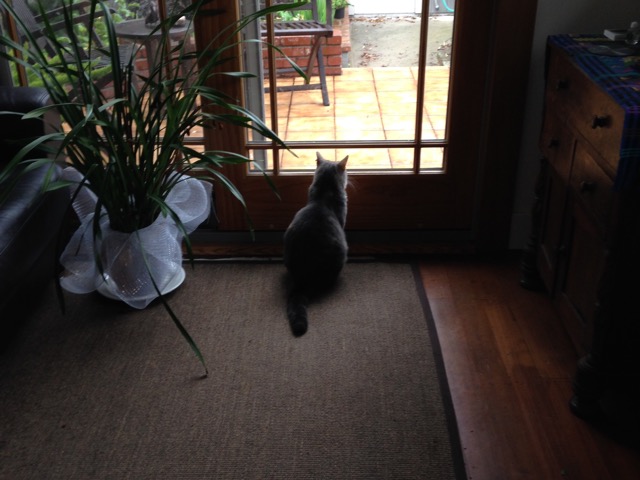
IMG_1274 Cat, Looking for Light

‘As if the sorrows of this world could overwhelm me
now that I realize what we are.
I wish everyone could realize this.
But there is no way of telling people
they are all actually walking around shining
like the brightest sun.’
Thomas Merton

The world was always there for me – gurgling with joy, shining like the brightest sun, fragrant-full, slippery and hard-edged, colorful beyond belief – and there I was, walking around with my head in the clouds, my eyes toward the ground.

I have a good mind, but living from that linear place didn’t work for me forever, thank God. My best thinking brought me straight into a long and deep depression almost 20 years ago. Life has not been the same, since. Today, I am grateful to be alive, and every day offers new delicacies for my delight. The gift of being a Monk in the World is that I get to enjoy what has been there all along, and I get to enjoy it as if it is new, as if it has never been witnessed before.

Many years ago, I learned to pray after reading The Christian’s Secret to a Happy Life, by Hannah Whitall Smith (of the American Holiness Movement). That was the beginning of a long, rich, and growing walk as a Monk in the World. I studied theology and became a preacher, a way to offer to others the gift of knowing we are not separate, we are not alone. I found strength and power and growing self-acceptance through prayer. After all this time, I still believe we can change the world by praying, by praying for ourselves, which grows us into Love.

I’m as inter-faith as I am Christian, knowing that the Light, the Universe, the Christ, the Mother, the Holy One, El, is in us all. Or maybe we are swimming in this Holy One. I struggle to find words for this life, this living.

I learned to meditate over 4 years ago, and this practice has deepened me. My greatest joy in meditation is that I find myself more present in the moment, moment by moment, day by day. I see things I did not see before. I delight in the branches of the birch tree outside my city window; I watch the seasons and winds bring change to that tree. I say: “I love that tree, and that tree loves me.” It’s true.

When I meditate, I find the boundaries between myself and the world dissolving. I feel the sound of a neighbor’s voice, the boom of a truck on the street, the harsh call of a jay, the wind in the eucalyptus trees, as much as I hear them. I suppose this is being one with all of creation. For me, it is not as clear as that, but I am beginning to understand, to know.

As a preacher, I  served a community of faith. My work as a Monk in the world was very extroverted for this introvert! I had the privilege of being called to be with others in their times of deepest need – learning a diagnosis that would take a beloved woman’s life, baptizing an infant who would not go home from the hospital, as she lay in the arms of her teenage mother, rushing into a hospital emergency room only minutes before the death of a vibrant woman in her 50’s, as her partner lay sobbing on top of her; I’ve sat in silence and watched the minutes tick away, waiting for surgery to end, with a frightened wife. I’ve answered the door to find a man who has not slept in days, smelling of the street, who tells me his long and convoluted story, only to ask me for a few dollars for food. I’ve heard many of those stories, and even though I do not understand, I have prayed with each one, knowing I have not have ever known that particular desperation. I’ve witnessed the suffering of the mentally ill who come to Church, hoping for something; I have been  blessed by my own illness to be able to see the suffering person, trapped by their mind, beneath what we label “stigma.”

After 30 years of serving as “Pastor,” I am only grateful. For whatever service I have been able to give, I am grateful. The gift has been mine, truly, truly.

All of this is to say that I am still looking to see the light Thomas Merton, one of my spiritual mentors, must surely have seen. The light is so ordinary, I’m sure. I know with a keen knowing that we are all light, that we are swimming in this light. I’ve felt it for a moment when I meditate, I’ve seen it shimmer – just a glimpse! – in the new-green, heart-shaped leaves of my beloved birch tree.

I am a mendicant now, begging for alms. I am a mendicant, raising my eyes to look into the eyes of whoever crosses my path. I am a mendicant, wanting to trust each day’s needs and gifts to the Holy One. I am a mendicant, looking for Light.

**

This was published in July, 2014, as a “Monk in the World” guest post at Abbey of the Arts.

Uncategorized

“I Am Not I”

IMG_0757

“I Am Not I”
By Juan Ramón Jiménez (translated by Robert Bly)
I am not I.
I am this one
walking beside me whom I do not see,
whom at times I manage to visit,
and whom at other times I forget;
who remains calm and silent while I talk,
and forgives, gently, when I hate,
who walks where I am not,
who will remain standing when I die.


Uncategorized

This holy time…

FullSizeRender

When I was a young girl, my mother told me the story of Jesus dying on the cross on Good Friday. I know she had told me the story to explain why I couldn’t go off and play that afternoon, and so I stayed dutifully in front of our flat on Ring Street.

I don’t remember Mom telling me the story, but I do remember hanging from the iron hand-rail that led to the sidewalk, thinking about a man who was dying somewhere that afternoon, on a cross.  I remember looking out across the street, imagining the scene in my child’s mind.  I wondered about him.  I had a sense of loneliness, as if loneliness hung in the air that day.   I couldn’t see what was happening, but it was somewhere, then, in present time.

It was a quiet afternoon.  In the 1950’s, activity stopped and stores closed from 12 to 3 on Good Friday afternoon.  Folks who went to church, did.  And many folks did in that Midwestern city, good and faithful church folks who sat for 3 hours listening to sermons about the 7 last words Jesus spoke.  Then, they returned to whatever else they were doing.  In Milwaukee, I’m sure, Friday fish fry meals at taverns across the city and state would be full that evening, as they usually were.

My family were not church-going people, and so it seems strange, in a way, that Mom told me the story, but she did.  Stories have power even when they are not our stories.  Stories that are told, again and again, have more power.  Stories have more power than fact or history, truly.   And stories we tell become our stories, have a way of working their wonder and fear and meaning inside of us, all the time.

***

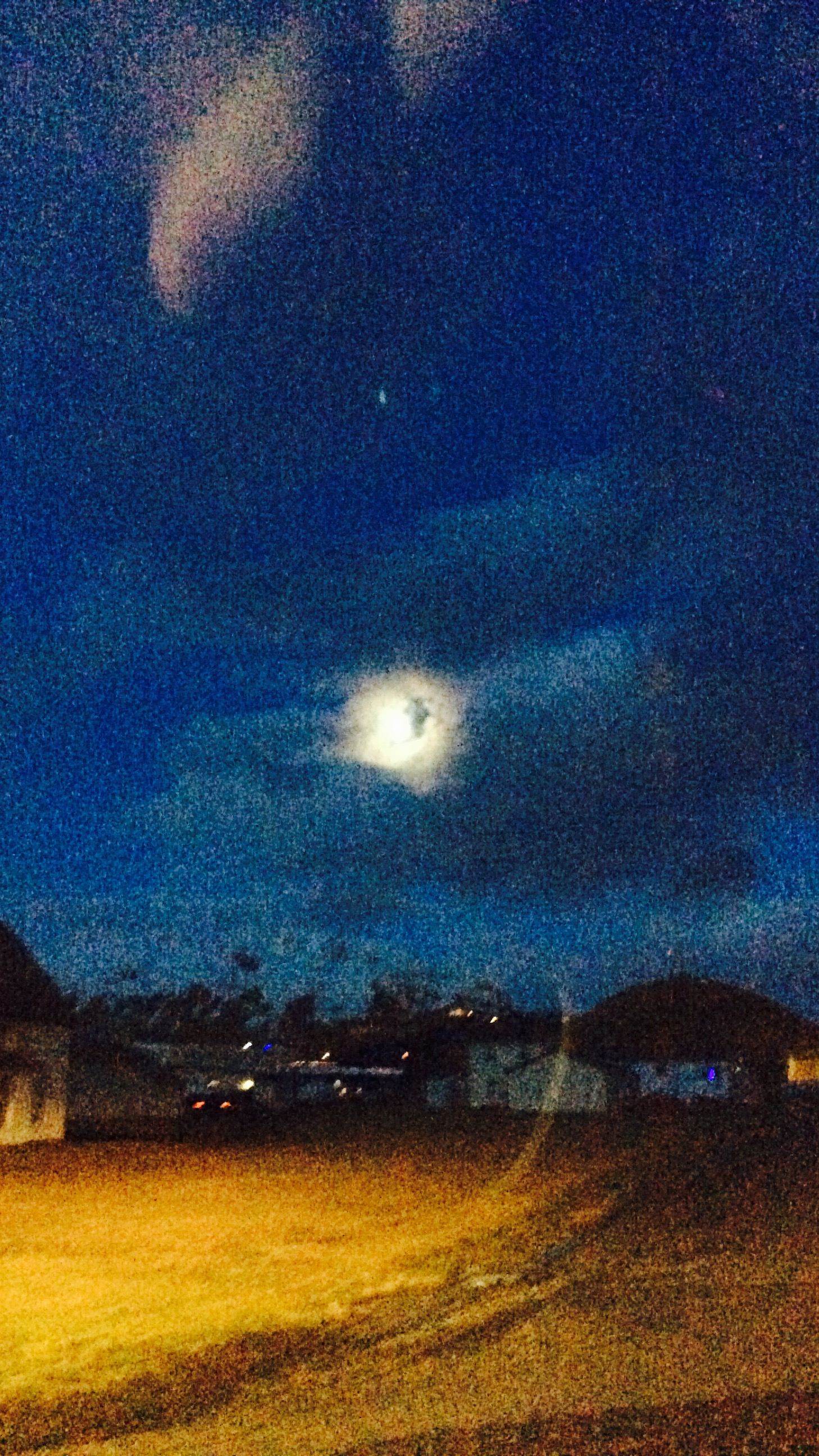
Now, I love the quiet season of Lent, that time of year when winter gives way to spring, slowly, with each lengthening day, with early buds on slender branches, with each storm that may be the last for the season.  And I love the movement of the moon across the sky.  I wait for the evening when I see the Pascal moon, the full moon that heralds Passover and Easter, an off-shoot of Passover.  That same moon marked the day and time for the telling of the story, Jesus taking a meal with his closest friends, honoring the ancient story, also.  The moon marks the time when winter slinks into spring, when green appears, when life that was under the earth comes back from the death of winter.

I watch the moon.  For as much as we modern folks know, moon is mystery.  For a time, it gives reflected light that lights up the white cover on my bed as if it was lit from within.  In the evening and night, moonlight comes into the bedroom, and by morning, it is far across the sky, hanging over the Pacific in the west.

Moon is mystery enough.  All those other things, those theological understandings and explanations, do no justice to the moon.  The passing of time is mystery enough, also, that I would reach back in memory today to see myself hanging from that bar, on that lonely day, the street quiet, and me, safe  in the assurance that Mom was close by, checking on me from the upstairs window, often.