1988. The times were very different from these times. The world was changing – quickly, it seemed. I was in my fourth and final year as the Associate Pastor of First United Methodist Church in downtown San Jose. And I had learned about a trip sponsored by the World Council of Churches to travel to the Soviet Union to honor the 1000 anniversary of the introduction of Christianity to Russia.
The congregation I was leaving gifted me – through the donations of several folks – what was needed to travel to the Soviet Union as part of a delegation of Americans sponsored by the World Council of Churches. I was grateful – and very excited – to see what was part of my family’s homeland. My mother’s parents – my maternal grandparents – had immigrated to the United States from Ukraine in 1914. They had held onto the hope for their people, even in the New World, expecting that the formation of the Soviet State would bring freedom. History would prove otherwise, of course (once – having received as a gift, a large volume about Stalin’s time, I’d had to stop reading when Stalin’s slaughter of the Ukrainians numbered well over 10 million people – primarily in the 1930’s). Their hopes did not correspond to the life they had here.
The trip began with several days of study of the Soviet Union and the Orthodox Church tradition in Brooklyn, New York, before the group made the journey to Moscow. Since we were guests in a Communist country, our group had been assigned to travel to events in several cities, and without our consent, the group was divided into smaller groups with different itineraries when we arrived in Moscow. I traveled to Moscow, St. Petersburg, Kiev, and to Odessa, a beautiful city on the Black Sea.
In the Soviet Union, the time had received the name, perestroika – restructuring of the economy. The people of the USSR – and the world – had hopes for the new Soviet Union. It was an exciting time to be in the USSR as a foreign visitor; indeed, the WCC trip coincided with the visit of Ronald Reagan, the U.S. President, to the USSR.
I was as close as I would ever be to “my people,” the people of Eastern Europe. As the years have unfolded, I have learned that my family – who had broken with “Church” by some turn of events in Ukraine, before emigration – must have been Catholic, a common faith and practice in Ukraine. Still, I was grateful for the introduction to the Eastern Church, the Orthodox Church. For me, traveling with the WCC was a doorway into a deeper look at life in the USSR – one doorway among many.
And so I was privileged to see the homeland, over fifty years after my grandparents had left their home. My privilege was reflected in another way; I told my mother about the trip, and invited her to join us, to finally secure her passport, to see the place where her people had lived, and where some still lived. She couldn’t see herself traveling that distance, and out of the country, and so she did not join the trip.
I’ve been inside many churches in my lifetime – to be sure. And there in the Soviet Union, I saw some of the most beautiful churches I have ever seen. The high arched ceilings, the iconography, the beauty of those places touched me. Even more, the babushkas – the poor women who came to the church with their prayers in their hearts, who bowed, again and again, standing before the saint to whom they gave their prayers – touched my heart. I carry their devotion with me, even now.
We learned that the Soviets – atheists – had protected the churches through all the years of the USSR, since 1917. They, too, had been moved by the beauty of those places. When the anniversary of the Orthodox Church was being planned, minutes from the organizing included these words: “Members of the Bishops’ Pre-Council Meeting gratefully consider it necessary to note the positive attitude of the Soviet Government to the questions put forward by the Hierarchy of the Church.” In other words, the government had agreed to allow the celebrations.
When we were not in churches, my roommate and I walked through the streets of the cities we visited. And in Kiev it was that I saw “my people.” The faces, the eyes, the way the people carried themselves – I recognized. They are forever “my people.” The days we were in Kiev were beautiful spring days. The lilacs were in blossom. The people felt the freedom of the spring as well as the changing times – as difficult as the present and the days to come – like all the days in the past – would be.
*
When I read the news these days, the world hears rumblings again coming from that Eastern place, now called Russia, again. I often think that Putin, President Putin, has never lost his history as KGB, and so he rattles the chains to control the people of his country – and the people of Ukraine, a sovereign nation. We may see the lock-down, the disappearing of that place as a free land – again.
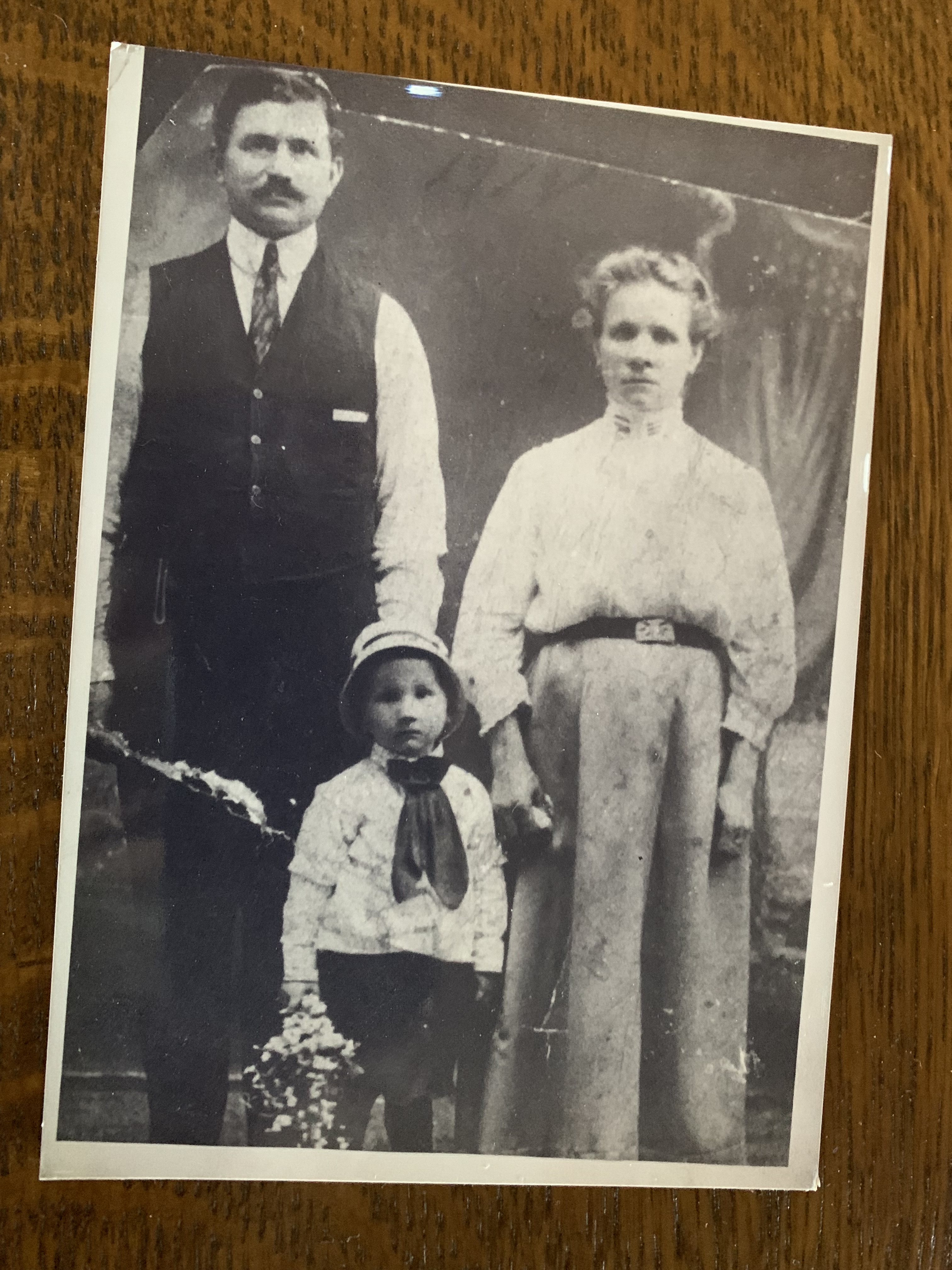
On the back of this photo, in my mother’s hand: Vlas Markov Srebny Feodosia Maksuda Srebna, Ivanka (Ivan, little one) Srebny, 4 yrs. old . Photo circa 1914.
