Those who will not slip beneath
the still surface on the well of grief
turning downward through its black water
to the place we cannot breathe
will never know the source from which we drink,
the secret water, cold and clear,
nor find in the darkness glimmering
the small round coins
thrown by those who wished for something else.
Like a person at the table, Steelworkers Union 19806 was always in my life when I was growing up. From time to time, my father would come home from work with rumors that a strike was in the works, that there might be a day when the local Steelworkers would strike, and he’d be on the picket line, proudly holding a sign, doing his part for himself and the rest of the union members.
I grew up with the language of labor unions spoken at the table, words like “strike” and “collective bargaining,” and “walk out.” My father, Frank Bahlert, was a hard working inspector at A.O. Smith Corporation in Milwaukee. He spent his days crawling over steel frames, measuring – showing up to work, to work hard. Being part of the Union was part of showing up.
My uncles, although they did not always understand my father, respected him. They respected that he was a hard-working laborer. He’d been grateful to get a job at all after the Depression years which dragged into the 1940’s, and he didn’t look for a wife until after he’d landed that Union job with good wages. He was already 38 years old when he married my mother; after the wedding, Mom quit her job. Now, I think her earning power was greater than my father’s, but they worked out their life as a married couple – a working class married couple of the 1950’s.
My father was proud of me when I graduated college and started working for the Federal Government. He was proud of what I earned – my beginning salary for the year higher than his hourly wage at A.O.Smith brought him at the end of his working days. He retired at 65, still strong after recovering from a heart attack. For years afterward, he would dream about work.
The men who worked with my father saw his work ethic, and they trusted his work. When he suffered the heart attack, a man who’d worked on the floor with my father came to the house to use the big clippers to trim the hedges that lined the walk up to the porch, part of my father’s work as a renter in a Milwaukee flat. Another showed up another day to cut the lawn. Dad watched his fellow union workers from the upstairs front window, hoping he’d be back to doing the job some day. And he was.
In the years before he retired, Dad’s union colleagues made sure he had a job and a title in the union; he checked to see that all the members were in the union hall and seated before he gave the nod for the sergeant at arms to call the meeting to order. I remember his face the day he went off to the first meeting in his new role, his hands shaking as he walked out the door in a clean shirt, his union badge pinned to the front pocket. He was nervous, and he was eager, also, to do what he could as a member. His fellow union men had shown their respect for his work ethic by giving him a role in union proceedings.
Once a year, the union would sponsor a picnic, and so the families of these hard working steel workers met one another. When I was in Junior High, I bowled each Saturday morning with the young sons and daughters of other members of Steelworkers Union 19806.
After I graduated college and before I took my first job that required a degree, I worked for a few months at A.O. Smith Corporation. Assigned to an office, I started that job by learning the file systems – and by doing the filing for the large office staff. In the morning, as I walked from the street into the building, I stood in line with the rest of my co-workers, clocking in at the machine on the wall. The steps from the street to the door that led to the corporation offices led through that steel mill, and I saw for the first time that loud and dirty place where Dad spent his days.
He loved his work. Every day, he came home with stories, telling mom, recounting in his animated way what the men had talked about at morning break. In front of the television in the evenings, sometimes he’d show us a steel sliver in his hand, and Suzie, my younger sister, would kneel in front of his chair, working the sliver out. Some days, Dad would tell us in a low voice that a man had been killed that day in the steel mill. At the door of the factory stood a large sign announcing the number of days since there’d been an accident.
*
I like to drive past what used to be the A.O. Smith Corporation in Milwaukee, when I’m able to return. The streets around the plant are empty now, deserted, the building that once buzzed with hard working life 24 hours a day, quiet. I think about Dad. I remember his face. I remember how he loved his work, how he loved being able to work at a steady job that allowed him to start a family. I remember the pride in his voice when he reminded us of how many years he’d been at that work as an inspector. I see his eyes, shining.
And when I read in the news that the United Auto workers are striking across the country, I quietly agree. They are my people.
Autumn in the Midwest is magical. The air has a feel to it, a feel touched with delight at the beauty all around, a feel touched with sadness and a kind of longing. Often, the autumn comes quickly, the leaves falling around, the color of the air changing, also. In the Midwest, we know that these magical days will be quickly followed by cold, by wind off the Great Lakes, by gray skies that go on for a long distance – and for a long time.
Autumn here in the West does not hold the magic that autumn in the Midwest held for me. Still, I watch with interest as the squirrels, tails twitching, climb quickly on their short legs across the branches of trees, scavengers, making plans for the winter. The squirrel that lives in my tree moves with a kind of stealth, watching me – my outline in the window – body turned to the side to give a full on view of this stranger, a look filled with confusion, and fear. And then the squirrel runs away, out of sight, out of danger. I know we inhabit the same place on earth, but our lives are so very different: I watch the squirrel with interest; the squirrel watches me with fear.
We both know, though, that time is passing, that the light is changing, day by day, and that the days are shortening.
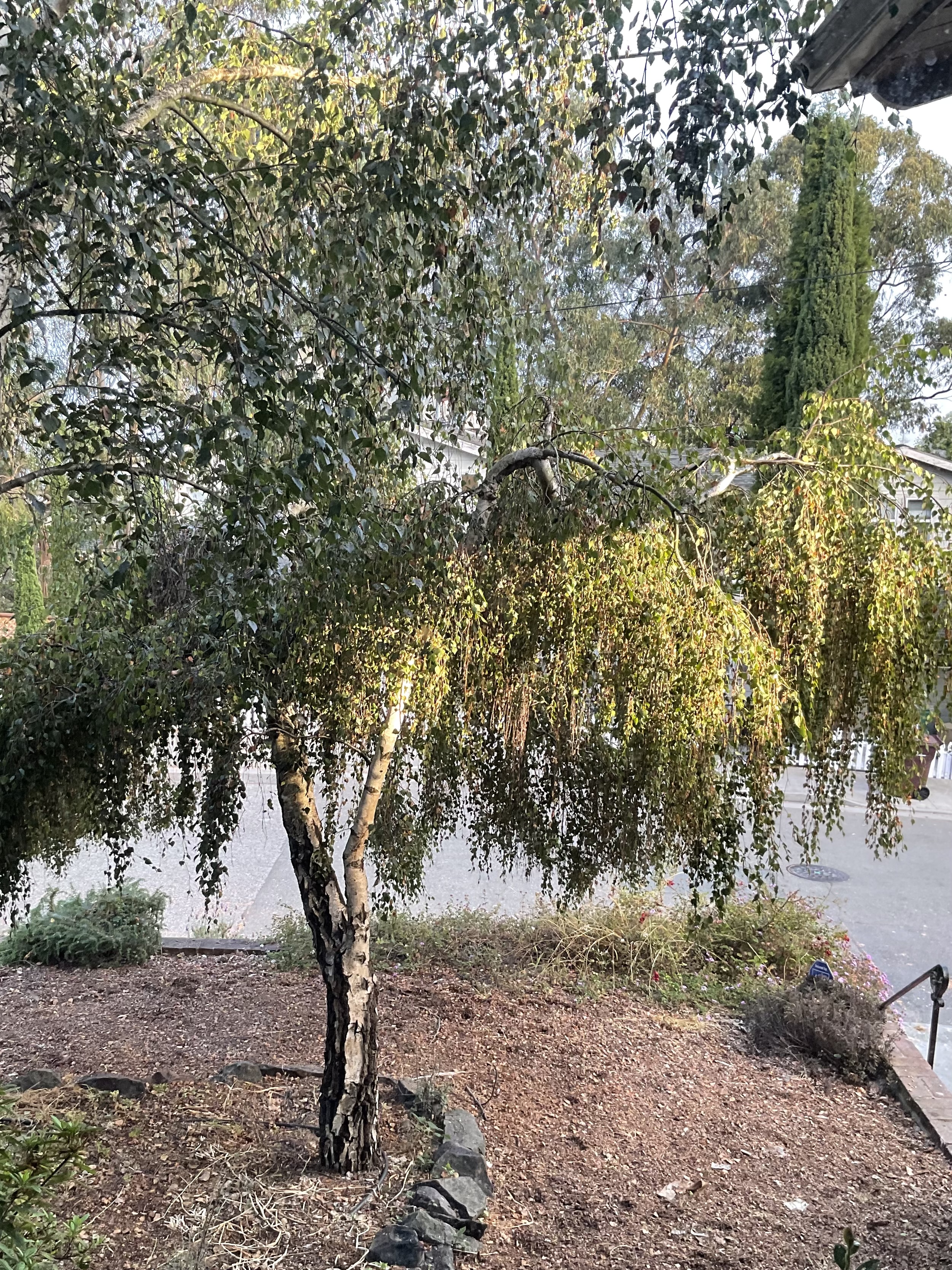
I miss the luxury of autumn in the Midwest, where the trees gladly hold their colorful branches into the sky. Even so, I see autumn here in the West, a long, slow autumn that begins with a subtle change in the greens of grass, the trees. Soon, the leaves on the birch tree I’ve watched so long outside my window – the birch tree that is part of me, part of this place – will begin to yellow. The leaves fall late from that tree; it holds on to the summer green longer than the trees around it.
We are waiting. The tree is waiting. I am waiting. We are waiting for just the right moment. Like my life, which has passed so quickly from the little girl who walked on the crunching leaves to school to this elder, looking at the leaves from her window – the tree will not let go ahead of its time. Nothing can force it. Nothing can make it lose its turn to softly let go.
And so, each day, I gaze carefully at my friend, my companion, that faithful tree. I gaze, I wait. The tree waits (I think). We are waiting for what only the passage of time will bring us.
See! The tree waits! – Photo by Mary Elyn Bahlert, 9/2023
My father was extroverted and his sister Irene was extroverted. Really extroverted: the kind of extrovert that spoke everything that passed through her mind. And I loved her.
Auntie Irene and her husband, Uncle Erdreich, lived on a road off the State Road 57 going north along the shore of Lake Michigan, north of Baileys Harbor. Their road led into a swamp, a mile or so past their house, their house with the cottage behind it – the cottage that Uncle Erdreich had built for my grandparents to live in in their elder years. The door of Auntie Irene’s house led to a hall that led to another door into the kitchen, the table directly ahead as you walked into the house. I suppose that house was strange by modern standards of “footprint,” as rooms had been added on by Erdreich, a carpenter, as the need had presented itself over the years.
I spent many nights in a second story bedroom at the top of the winding stairs that led from the living room to that unused space; unused, since Irene and Erdrich’s two sons were a generation older than me, and were long past away from Baileys Harbor, making their lives in other places. When I was living in Green Bay for a couple of lonely years in my twenties, a few times I made the trip to Baileys Harbor to spend a day or two with Auntie Irene and Uncle Erdreich. I slept in that cozy bedroom with its old fashioned pictures on the wall many times.
Irene was “the hugger” to my sister Suzie. That’s how Suzie remembered her as being different from Edna, a quiet Bahlert, who lived twenty miles to the north, near the tip of Death’s Door at the end of the Door Peninsula. And Irene did welcome us all with a hug, as her mother had done, a generation before, when she welcomed my reserved mother into the family as she met her for the first time. My mother never forgot that hug of kindness and acceptance.
Irene and Erdreich rarely went more than a few miles from their home, but they did come to Milwaukee to visit my family when my sister was still in a stroller. The Big Sister (as Irene had been to her Bahlert siblings) took the baby and Auntie Irene for a walk, Auntie Irene anxious, talking non-stop as soon as we were out of sight of the house where my family lived.
Irene hugged and Irene talked. Is it a truth about extroverts that they say exactly what comes into their mind? I think that was true of Irene. She was kind; she was gentle; she was warm and she had a humor about her. When my parents and Suzie and I had been greeted on the lawn with hugs, we were given a tour of the garden that was full of vegetables and fruits every year, and then we walked into the kitchen of the welcoming house for a treat at the table, something home baked by Auntie Irene.
On one of the trips to Door County during my years in Green Bay, I invited a friend to join me for the weekend, and we were the guests of my loving aunt and her home cooked meals. As we drove away, my friend turned to me in the car and said: “there’s no excuse for a person to be like that.” Her comment surprised me, and it still surprises me that I did not feel shame at her judgment of a person I loved so completely. Years later, I introduced another friend to Irene and Erdreich, and she told me that she had never met people like them before. Her comment reminded me of her kindness and gentle acceptance.
When Irene was in a nursing home, already past 90, dying, I wrote a note to her. I’m sure someone must have read it to her as she lay in her bed, that lonely bed away from the double bed she’d shared for 70 years with Erdreich. As I signed the note, I remember writing: “wait for me.” Jeff and I made the trip to Door County again on our visit “home” to Wisconsin that year, just in time to be present at Auntie Irene’s funeral in the Evangelical Lutheran Church along the highway, the church where, years before, I’d sat in the pew after receiving communion, next to my aunt who fell to her knees, head bent, before she sat back in the pew. I’ve always thought that Auntie Irene had waited for me return, for me to be present alongside my Bahlert cousins, some who came from a long way to be at her funeral, on that summer day.