I leaned over the railing of the front porch of the Upper Flat on Ring Street, and I craned my head to look down the alley to the left. A long way down the alley – almost to Burleigh Street – I saw the little figure, long dark coat almost touching the ground – of Grandma. She walked slowly – my Grandma was old – and she looked down at the pavement. Careful. Old. As she got closer, I saw her head was wrapped in a thick black scarf decorated with the bright colors of flowers. The scarf covered her hair, except for the hairline in the front, and she had tied it in a knot at the back of her neck. She didn’t look up, not even once.
When Grandma came up the narrow stairs and into the flat, I watched her from the other side of the living room. She looked at me once, twice, and a little smile came to her face. And then she talked, but only to Mom. They spoke their own language when she came over, and I didn’t understand. So I played on the floor across from the couch and listened. I listened and listened. What did they say? I listened and listened.
Years later, after she died, Grandma would come to me, as if in a dream. And she stayed with me for a long time. “Why did she come to me?” I asked a friend. “Who else would she go to?” she answered, wisely.
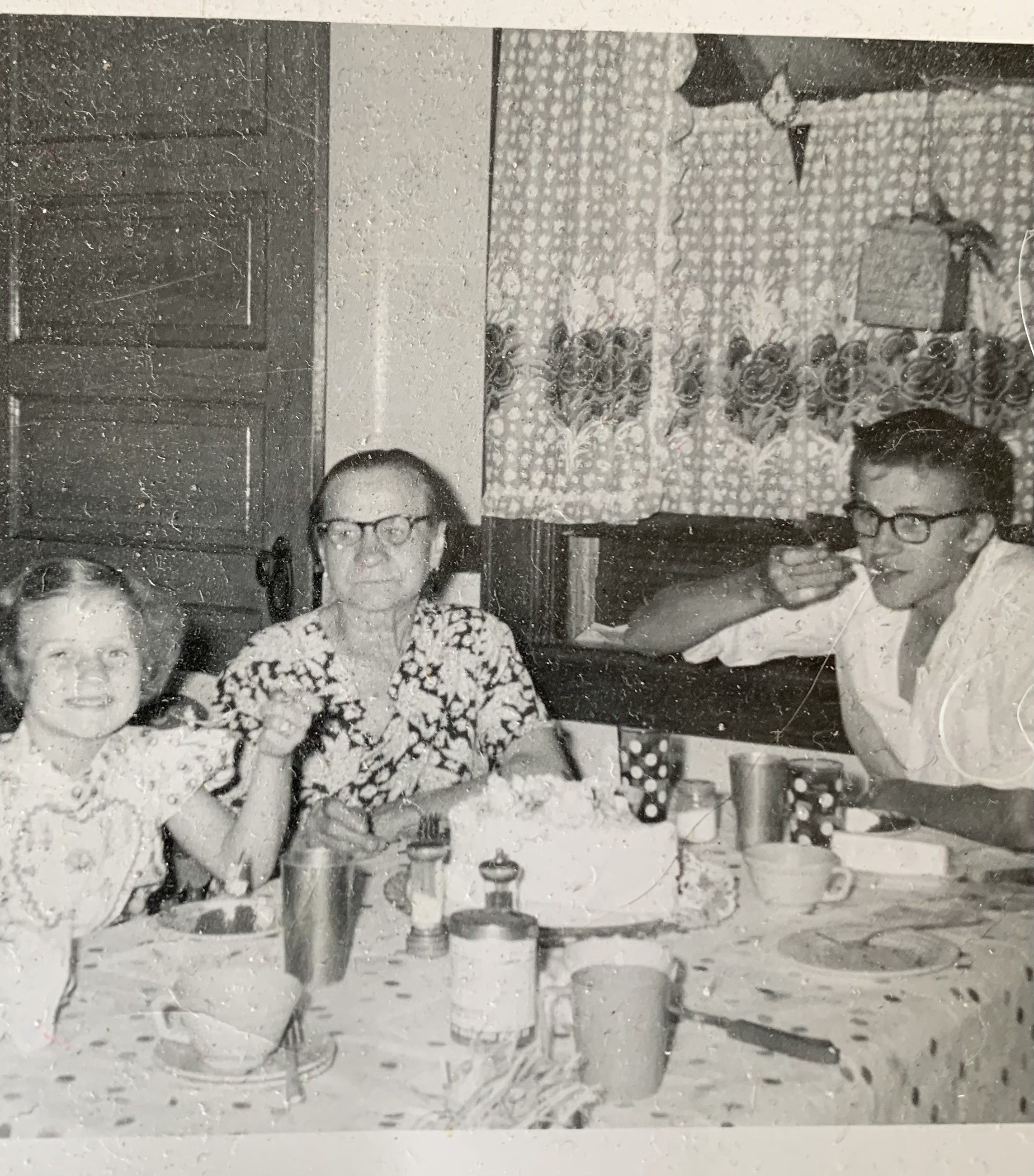
My favorite picture of Grandma – Feodosia Machsuda Srebny – shows her with a little smile on her face, sitting with me and Ronnie at the table. Ronnie wanted to be cool, a teenager. I love the picture because she is smiling, and her eyes are smiling. I don’t think of her as smiling, a little foreign woman – foreign even to me – poor, sad. When she was older she didn’t say any words in English. She forgot. Only Mom could talk to her then.
At Easter, we decorated eggs – some in the old fashioned way, pysanke – and some just dipped into colors: blue, pink, yellow. We blew raw eggs out through holes on the ends and Mom took hours to craft hers. Ronnie was good at it, I think. And Mom. But Grandma didn’t make the eggs. She sat on the couch in her long black dress, her dark hair held back in a loose bun, streaked with gray, her fingers bent as she tried to crack eggs with Suzie.
Daddy and I would go to get her at the nursing home and bring her home for Easter dinner. And soon after dinner, she’d look at my mother again and again, asking to go home. Mom did the same thing when she got old.


I loved the touching story of your Grandma. And the photo is precious!
LikeLike
Your lovely story took me down a pysanke rabbit hole and I wound up watching a wonderful YouTube tutorial on how to make them. It included a bit of the symbology of the designs as well as how to make them. What a beautiful tradition and practice! For others that want to go down that rabbit hole try this video. https://youtu.be/LjcKizt9n5A?si=4JmEB_2EFIbBo8lY
LikeLiked by 1 person
Wow! Thank you for this, Sherri! Let me know if you make pysanke! If you want to see them, I still have some of my mother’s!
LikeLike
I remember dad showing us how to poke a hole in the egg and blow it out but he also showed us how to prank someone and break the empty egg on their head 🤣 thanks for sharing this I love the picture with my dad in it ❤️❤️
LikeLike
Oh, this is a beautiful story, Mary Elyn. I loved my Grandma Emma so much, too. A Yiddish speaking immigrant from Belarus. I made potato soup yesterday and remembered how much I loved hers.
What a wonderful thing your writing is! Such a deep and honoring practice on your part and so evocative in the hearts of your readers. Thank you, sending love, Phyllis
LikeLiked by 1 person
Oh Phyllis, thank you so much for being a faithful reader of my blog! Yes it is a practice for me, and I’m happy that I set it as a goal. I love that you made your Grandma’s soup, too. I make my family’s borscht recipe at least once a year, and I remember those who are gone.
LikeLike
I’d love to see your mom’s eggs!
LikeLike
I’ll email you Sherri. I can get your info from the LMUMC address book. Let’s take our chat there!
LikeLike